About 333 minutes
Melmoth the Wanderer, Vol. 4 — A Reader’s Guide
Wandering Heroes Classic Adventures
76,525 recorded words. 55 minutes difference from this book's estimate.
View Gutenberg source #53688
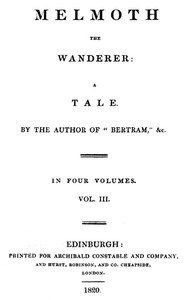
The catalog record for Melmoth the Wanderer, Vol. 3 — Story, Setting & Ideas provides practical reading context through 63,801 words, 4 hr 38 min estimated reading time, and 13 detected text sections.
The text analysis averages about 28.5 words per sentence, while the detected sections provide another way to judge how the source is divided.
Project Gutenberg metadata also associates the work with “Horror tales,” connecting these edition facts with the source record’s subject description.
Explore this collection
These alternatives are selected using recorded categories and estimated reading time.
About 333 minutes
Wandering Heroes Classic Adventures
76,525 recorded words. 55 minutes difference from this book's estimate.
View Gutenberg source #53688About 338 minutes
Wandering Heroes Classic Adventures
77,526 recorded words. 60 minutes difference from this book's estimate.
View Gutenberg source #60339About 355 minutes
Wandering Heroes Classic Adventures
81,630 recorded words. 77 minutes difference from this book's estimate.
View Gutenberg source #67753Search stored excerpts and compare books → Choose by your preferences →
Choices use stored catalog measurements. Estimates vary with reading speed. A shared category is a catalog label, not a claim that two books have the same argument or literary quality.
Search reads excerpt text stored with this catalog and links to its associated Gutenberg record. The connection is stored in the site database; this tool does not recheck that every excerpt is word-for-word identical to that external record. Excerpt search does not cover every chapter and does not verify historical publication dates.
Catalog snapshot checked: 2026-09-25. Coverage: 100 public books, 100 available source excerpts.
Read the complete public-domain text at its original source.
Read on Project GutenbergMaturin’s prose in this volume often relies on stark contrasts to heighten dramatic tension. In the storm scene, the Wanderer is described as “armed with all his malignity and all his power,” while Immalee stands “armed only with her purity.” The narrator emphasizes the disparity between her vulnerability and his destructive intent, a pattern that recurs throughout the excerpts. The setting itself—a dark room with a Hebrew Bible mistaken for a magic book, or a rocky shore during a tempest—functions as more than backdrop; it mirrors the moral and psychological stakes of each encounter.
Maturin’s word choices consistently polarize the Wanderer and his victims. The Wanderer is associated with “malignity,” “poisonous potency,” and “subtle” power—terms that suggest an almost supernatural corruption. Immalee, by contrast, is described through images of light and softness: “the light of her figure shining out amid the darkness,” “undulating softness,” “flexibility.” The narrator even compares her to “the reflected beam of the last ray of light.” This lexical opposition reinforces the moral geometry of the scene: the Wanderer embodies a force that seeks to extinguish innocence, while Immalee’s purity is portrayed as a fragile but radiant counterforce.
Immalee’s speech is rendered as a “wild song of desperation and love,” a lyrical monologue that blends natural imagery with emotional longing. She sings of darkness, lightning, and the ocean, but each element is reframed in terms of the Wanderer’s absence: “The night is growing dark—but what is that to the darkness that his absence has cast on my soul?” The song’s repetitive structure and parallel clauses (“When we first met… now…”) create a rhythmic lament that contrasts sharply with the Wanderer’s terse, manipulative utterances elsewhere. Maturin uses this poetic dialogue to externalize Immalee’s inner state, making her vulnerability audible even as the storm rages around her.
One of the volume’s most striking descriptive passages occurs when the narrator stumbles into a hidden room. The details are carefully chosen to evoke a sense of forbidden ritual: a “vessel of a singular construction,” a book with indecipherable letters (later revealed as a Hebrew Bible with Samaritan points), a knife, and a cock tied to a table leg. The narrator’s reaction—taking the book “for a book of magic” and closing it “with a feeling of exculpatory horror”—reveals how Maturin uses the protagonist’s ignorance to amplify the uncanny. The description is precise yet ominous, leaving the reader uncertain whether the scene is a preparation for sacrifice or a misunderstood religious rite.
Maturin structures key scenes to delay revelation, building suspense through physical and perceptual obstacles. In the chamber scene, the narrator’s fall bursts open a door and a curtain, but he remains concealed behind its folds, observing before being observed. Similarly, in the storm scene, the Wanderer approaches Immalee “unobserved” because his steps are drowned by the ocean and wind. The reader is placed in a position of privileged awareness, watching the danger unfold before the victim does. This structural choice heightens the sense of impending doom and underscores the power imbalance between the knowing predator and the unknowing prey.
Readers attentive to Maturin’s craft will notice how he uses diction, dialogue, and description not merely to decorate the narrative but to embody the central conflict between innocence and corruption. The storm scene, in particular, rewards close reading for its layered contrasts—light and dark, song and silence, purity and malignity. These authorial choices give the volume its distinctive Gothic texture, where every element of style serves the story’s moral and emotional gravity.
There’s something about the way Maturin lets the storm press against Immalee’s window that stays with you, that particular hush before terror speaks. It reminds me of another old book, Don Miguel Lehumada: discoverer of liquid from the sun's rays an occult romance of Mexico and the United States — Context and Discussion, where the sunlight itself feels borrowed and heavy. Both leave a strange afterglow, like waking from someone else’s dream.
Save your reaction, strongest insight, and memorable passage.