About 105 minutes
The History of Don Quixote, Volume 1, Part 09 — Themes and Context
Wandering Heroes Classic Adventures
23,929 recorded words. 2 minutes difference from this book's estimate.
View Gutenberg source #5911
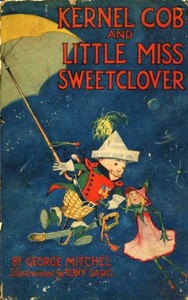
The source record for Kernel Cob And Little Miss Sweetclover — Text and Context measures this digital text at 23,504 words, 1 hr 43 min estimated reading time, and 3 detected text sections.
The text analysis averages about 17.4 words per sentence, while the detected sections provide another way to judge how the source is divided.
Project Gutenberg metadata also associates the work with “Fantasy literature,” connecting these edition facts with the source record’s subject description.
Explore this collection
These alternatives are selected using recorded categories and estimated reading time.
About 105 minutes
Wandering Heroes Classic Adventures
23,929 recorded words. 2 minutes difference from this book's estimate.
View Gutenberg source #5911About 110 minutes
Wandering Heroes Classic Adventures
25,146 recorded words. 7 minutes difference from this book's estimate.
View Gutenberg source #5909About 89 minutes
Wandering Heroes Classic Adventures
20,381 recorded words. 14 minutes difference from this book's estimate.
View Gutenberg source #5917Search stored excerpts and compare books → Choose by your preferences →
Choices use stored catalog measurements. Estimates vary with reading speed. A shared category is a catalog label, not a claim that two books have the same argument or literary quality.
Search reads excerpt text stored with this catalog and links to its associated Gutenberg record. The connection is stored in the site database; this tool does not recheck that every excerpt is word-for-word identical to that external record. Excerpt search does not cover every chapter and does not verify historical publication dates.
Catalog snapshot checked: 2026-09-25. Coverage: 100 public books, 100 available source excerpts.
Read the complete public-domain text at its original source.
Read on Project GutenbergThe story opens with Jackie and Peggs, children whose aunt has forgotten they need toys, so they fashion their own: a soldier from an ear of corn and a doll from sweetclover and morning-glory. These creations promptly come to life, named Kernel Cob and Little Miss Sweetclover, and are whisked away by a storm. The narrative voice is distinctive—colloquial and playful, with phrases like “maybe four hours or two” and “Goodie!”—but it never loses sight of the children’s underlying ache for their missing mother and father, whom they call “motheranfather” as a single word.
The opening chapters establish a tension between resourceful make-believe and the insufficiency of homemade substitutes. Jackie and Peggs have no store-bought toys, so they invent their own: Peggs’s doll is a morning-glory turned upside-down, tied with a four-o’clock flower for a bonnet; Jackie’s soldier is a corncob, but he lacks a jack-knife to carve it properly. The narrator notes the children “could only play at make-believe all day long,” yet their creations become real enough to act independently. This blurring of fantasy and need recurs when the dolls set out to find the children’s parents—a quest that the real children cannot undertake themselves. The story thus frames imagination not as pure escape, but as a response to absence.
When the dolls meet Jackie Tar, a sailor doll, the narrative shifts into a more worldly register. Jackie Tar speaks in nautical idioms (“Aye, aye, mates”) and recites a poem about sailing to “Vera Cruz to Zanzibar” and “Chili and Japan.” His knowledge of foreign ports contrasts with the children’s enclosed garden world. Yet the poem’s final couplet—“they can tell the tales they do / That children love to listen to”—suggests that adventure is ultimately for the sake of storytelling. The journey to India introduces a Hindu magician, but the characters initially confuse him with an American Indian, revealing a limited, bookish geography that the story itself tries to correct. The magician’s vision, which replays the storm that began the adventure, hints that the quest may be circular.
Two structural patterns emerge from the excerpts. First, storms bracket the action: a storm carries the dolls away, and a magician’s cloud-vision shows that same storm, suggesting the journey is a loop. Second, the compound word “motheranfather” appears as a single, breathless unit, spoken by Jackie Tar to the magician. This compression of parental figures into one word underscores the children’s unified longing. The magician’s vision reveals Jackie and Peggs playing with the dolls just before the storm—a moment that blurs past and present. These repetitions give the narrative a dreamlike quality, where events recur and the boundary between the children’s play and the dolls’ reality is porous. The excerpts do not reveal whether the quest succeeds, leaving the pattern unresolved.
Readers may find it useful to attend to the story’s shifting scale: the dolls are small enough to be carried by a storm, yet they travel across oceans. The narrative voice, which sometimes addresses the reader directly (“you may be sure”), also invites attention to how the tale frames its own telling. The poem about sailors, for instance, is both a character’s speech and a meta-commentary on adventure fiction. Observing these layers can enrich a reading of this early twentieth-century fantasy.
Sitting with Kernel Cob And Little Miss Sweetclover, I kept thinking how its quiet ache for missing parents lingered beneath the playfulness. That same gentle undertow haunts The Phantom Ship — Reading Companion, where longing drifts like fog around every voyage. Strange, how two such different stories can share that one soft pulse of grief.
Your answers remain private and are stored only in this browser.