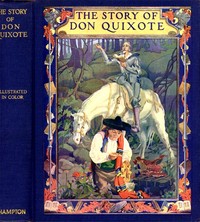
About 110 minutes
The History of Don Quixote, Volume 1, Part 07 — Edition Insights
Wandering Heroes Classic Adventures
25,146 recorded words. 60 minutes difference from this book's estimate.
View Gutenberg source #5909
This digital edition of The Golden Canyon — Background and Themes is described by source-level measurements including 38,989 words, 2 hr 50 min estimated reading time, and 4 detected text sections.
The text analysis averages about 16.0 words per sentence, while the detected sections provide another way to judge how the source is divided.
Project Gutenberg metadata also associates the work with “Adventure stories,” connecting these edition facts with the source record’s subject description.
Explore this collection
These alternatives are selected using recorded categories and estimated reading time.
About 110 minutes
Wandering Heroes Classic Adventures
25,146 recorded words. 60 minutes difference from this book's estimate.
View Gutenberg source #5909About 105 minutes
Wandering Heroes Classic Adventures
23,929 recorded words. 65 minutes difference from this book's estimate.
View Gutenberg source #5911About 103 minutes
Wandering Heroes Classic Adventures
23,504 recorded words. 67 minutes difference from this book's estimate.
View Gutenberg source #14110Search stored excerpts and compare books → Choose by your preferences →
Choices use stored catalog measurements. Estimates vary with reading speed. A shared category is a catalog label, not a claim that two books have the same argument or literary quality.
Search reads excerpt text stored with this catalog and links to its associated Gutenberg record. The connection is stored in the site database; this tool does not recheck that every excerpt is word-for-word identical to that external record. Excerpt search does not cover every chapter and does not verify historical publication dates.
Catalog snapshot checked: 2026-09-25. Coverage: 100 public books, 100 available source excerpts.
Read the complete public-domain text at its original source.
Read on Project GutenbergThe excerpts from The Golden Canyon reveal a narrative driven less by the pursuit of gold than by tactical movement through hostile terrain. The catalog subjects list treasure troves, rescues, and gold mines, yet the available passages focus on a running battle: characters coordinate retreats, calculate distances, and exchange fire with unseen opponents. The gold itself remains a distant objective, while the immediate concern is survival against a pursuing band.
Henty’s prose is lean and functional, prioritizing action over description. Dialogue carries exposition—characters relay plans in short, clipped sentences. The setting is sketched through practical details: a gorge that widens, a slope possible for horses, trees that serve as landmarks. This spare style keeps attention on the characters’ decisions and the physical challenges they face.
The excerpts show a group operating under shared expertise. Dave and Zeke issue orders without debate; the younger characters, like Dick, receive instructions and execute them. The dialogue is procedural: “Now you can be off back again,” Zeke says, and Dick returns at a run. There is no hesitation or questioning of authority.
When the attack comes, the group’s response is coordinated. Dave assigns positions: “do you two lads keep below; get down right among the rocks.” The firing is described in sequence—miners shoot first, then the lads, then the Colts. Casualties are counted: “seven out of twenty-five is a sharp lesson.” The language is clinical, emphasizing efficiency over emotion.
This dynamic suggests a story where competence and obedience are valued over individual heroism. The group functions as a unit, and the tension lies in whether their discipline will outlast the enemy’s numbers.
Terrain is described not for atmosphere but for its military utility. The gorge “widened rapidly”; the slope is “possible for horses to scramble up.” Trees on a crest become a “mark” for navigation. Darkness is timed: “it will be dark down here an hour before it is on the hill-tops.” Every feature is assessed for cover, line of sight, or escape.
Sound is also tactical. Dave hears the approaching band as “a low, continuous murmur that sounded to him like a distant waterfall.” The ability to interpret such cues separates the experienced from the inexperienced. The landscape is not a backdrop but a set of variables to be read and exploited.
This treatment of setting aligns with Henty’s reputation for embedding practical knowledge into adventure fiction. The reader learns, alongside the characters, how to judge distance, cover, and timing in a canyon environment.
The catalog lists “treasure troves” and “gold mines and mining” as primary subjects, yet the excerpts contain no gold, no mining, and no treasure. The word “gold” appears only in the title. The characters are called “gold-seekers” in a chapter heading, but their immediate activity is combat and evasion.
Rescue is also cataloged, but the excerpts show no rescue in progress. The group is trying to save themselves, not others. The catalog may reflect the book’s overall arc, but the available text suggests that the journey—and the obstacles encountered—occupies far more space than the discovery of gold.
Readers expecting a story centered on mining or treasure hunting will find instead a prolonged tactical retreat. The catalog’s emphasis on treasure may misrepresent the book’s actual focus on survival and group strategy.
The excerpts offer a narrow window into The Golden Canyon, limited to a single extended chase sequence. Readers should approach the catalog subjects with caution: the story may well involve gold and rescue, but the surviving text emphasizes combat, terrain, and command. Henty’s style rewards attention to practical detail—the way a character judges distance, chooses cover, or times a retreat. Those who enjoy tactical problem-solving in a historical frontier setting will find much to engage with here.
That rainy afternoon, I kept thinking about how Henty’s men trusted their compass more than their hopes. It made me wonder about other stubborn searches—those fueled by delusion rather than maps. So I drifted to The History of Don Quixote, Volume 1, Part 16 — A Closer Reading. Same gold, different fever; the canyon’s silence felt almost like La Mancha’s wind.
Answer a few questions and save a private reflection on this device.