About 501 minutes
Bonnie Prince Charlie : a Tale of Fontenoy and Culloden — Inside the Classic
Historical Psychological Social Fiction
115,025 recorded words. 7 minutes difference from this book's estimate.
View Gutenberg source #7006
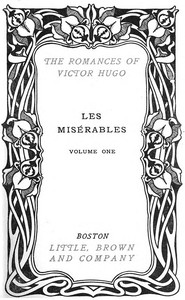
Les Misérables, v. 1/5: Fantine — Edition Insights can be approached with a clearer sense of reading commitment from its source measurements: 113,426 words, 8 hr 14 min estimated reading time, and 10 detected text sections.
The text analysis averages about 19.1 words per sentence, while the detected sections provide another way to judge how the source is divided.
Project Gutenberg metadata also associates the work with “Historical fiction,” connecting these edition facts with the source record’s subject description.
Explore this collection
These alternatives are selected using recorded categories and estimated reading time.
About 501 minutes
Historical Psychological Social Fiction
115,025 recorded words. 7 minutes difference from this book's estimate.
View Gutenberg source #7006About 478 minutes
Historical Psychological Social Fiction
109,753 recorded words. 16 minutes difference from this book's estimate.
View Gutenberg source #65309About 368 minutes
Historical Psychological Social Fiction
84,561 recorded words. 126 minutes difference from this book's estimate.
View Gutenberg source #69891Search stored excerpts and compare books → Choose by your preferences →
Choices use stored catalog measurements. Estimates vary with reading speed. A shared category is a catalog label, not a claim that two books have the same argument or literary quality.
Search reads excerpt text stored with this catalog and links to its associated Gutenberg record. The connection is stored in the site database; this tool does not recheck that every excerpt is word-for-word identical to that external record. Excerpt search does not cover every chapter and does not verify historical publication dates.
Catalog snapshot checked: 2026-09-25. Coverage: 100 public books, 100 available source excerpts.
Read the complete public-domain text at its original source.
Read on Project GutenbergThe first volume of Victor Hugo's Les Misérables opens not with its central characters but with an extended portrait of Bishop Myriel, a man whose quiet acts of charity and philosophical musings set the moral stage. Hugo's narrator moves at a deliberate, almost meditative pace in Book First, detailing the bishop's household, his beliefs, and his worn cassock. This slow accumulation of detail creates a sense of stability that will be sharply contrasted by the rapid, tense narrative of Jean Valjean's arrival and flight in Book Second.
The translation by Sir Lascelles Wraxall, authorized by Hugo himself, preserves the author's characteristic digressions and shifts in register. From the bishop's serene conversations to the frantic chase of Valjean, the prose modulates between reflective commentary and urgent action, a pattern that recurs throughout the volume.
The first book of Fantine is a study in narrative patience. Hugo devotes fourteen chapters to Bishop Myriel, a figure who performs no dramatic deeds but embodies a radical Christian humility. The narrator lingers on the bishop's household economy, his long walks, and his quiet conversations with the poor. The pace is unhurried, allowing the reader to absorb the bishop's philosophy before any plot machinery engages.
This slow opening serves a structural purpose: it establishes a moral baseline against which the rest of the volume's suffering and injustice will be measured. The bishop's simplicity—his willingness to give away his silver, his refusal to lock his door—creates a world where generosity is possible. Hugo's voice here is almost essayistic, breaking into direct commentary on society and religion. The effect is to make the reader feel the weight of the bishop's choices before the narrative accelerates into Valjean's desperate flight.
Book Second marks a dramatic shift in tempo. Where the bishop's story unfolded in measured scenes, Valjean's arrival at the bishop's door and his subsequent theft of the silver candlesticks is told with increasing urgency. The narrator's omniscient eye follows Valjean's internal turmoil, his sleepless night, and his flight into the countryside. The prose becomes more clipped, sentences shorter, as the ex-convict's panic mounts.
This change in pace is not merely stylistic; it mirrors Valjean's psychological state. The narrator describes his 'desperate man's heart' and the 'wave and darkness' of his thoughts. The encounter with little Gervais, where Valjean steals a coin from a child, is rendered in swift, almost brutal strokes. The contrast with the bishop's deliberate kindness is stark. Hugo uses this acceleration to dramatize the conflict between grace and habit, between the bishop's gift and Valjean's ingrained suspicion.
The volume's final books trace Fantine's story, and here the narrative pace becomes uneven, alternating between leisurely social panorama and sudden, devastating events. Book Third opens with a digression on the year 1817, listing cultural and political details in a catalog-like style. This broad view then narrows to the story of Fantine's love affair with Tholomyès, told with a mix of irony and pathos. The tone is almost light until the abrupt abandonment, which is handled with swift, almost clinical brevity.
As Fantine descends into poverty, the pace quickens again. Her journey to Montfermeil, her decision to leave Cosette with the Thénardiers, and her eventual fall into prostitution are narrated with increasing compression. The narrator's voice becomes more urgent, more openly indignant. The description of Fantine selling her hair and teeth is stark and unsparing. Hugo's shifts in pace—from expansive social commentary to tight, focused suffering—create a rhythm that mirrors the precariousness of his characters' lives.
Readers approaching Fantine should attend to how Hugo manipulates narrative tempo. The volume's structure—a slow moral prelude, a frantic middle, and a descending spiral—is not accidental. Pay particular attention to the transitions between books, where the narrator's voice often shifts register. The Wraxall translation, while Victorian in idiom, retains Hugo's rhetorical force. This first volume sets up conflicts that will echo through the remaining four, but it also stands as a complete arc of fall and redemption, albeit one that leaves the reader suspended in uncertainty.
Reading about Fantine’s quiet unraveling, I found myself thinking back to a much older afternoon with Pick a Crime — Inside the Classic. There is that same ache in the margins, both books watching someone slip through the cracks of a system that barely sees them. I remember setting it down and just staring out the window, the way Hugo makes you do.
Your answers remain private and are stored only in this browser.