About 324 minutes
The Hardy Country: Literary landmarks of the Wessex Novels — Context and Discussion
Historical Psychological Social Fiction
74,469 recorded words. 0 minutes difference from this book's estimate.
View Gutenberg source #46801
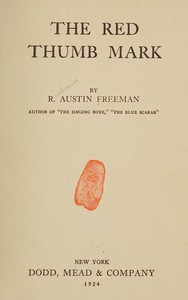
The catalog record for The Red Thumb Mark — A Closer Reading provides practical reading context through 74,379 words, 5 hr 24 min estimated reading time, and 8 detected text sections.
The text analysis averages about 19.3 words per sentence, while the detected sections provide another way to judge how the source is divided.
Project Gutenberg metadata also associates the work with “Detective and mystery stories,” connecting these edition facts with the source record’s subject description.
Explore this collection
These alternatives are selected using recorded categories and estimated reading time.
About 324 minutes
Historical Psychological Social Fiction
74,469 recorded words. 0 minutes difference from this book's estimate.
View Gutenberg source #46801About 340 minutes
Historical Psychological Social Fiction
77,973 recorded words. 16 minutes difference from this book's estimate.
View Gutenberg source #69913About 283 minutes
Historical Psychological Social Fiction
65,013 recorded words. 41 minutes difference from this book's estimate.
View Gutenberg source #58820Search stored excerpts and compare books → Choose by your preferences →
Choices use stored catalog measurements. Estimates vary with reading speed. A shared category is a catalog label, not a claim that two books have the same argument or literary quality.
Search reads excerpt text stored with this catalog and links to its associated Gutenberg record. The connection is stored in the site database; this tool does not recheck that every excerpt is word-for-word identical to that external record. Excerpt search does not cover every chapter and does not verify historical publication dates.
Catalog snapshot checked: 2026-09-25. Coverage: 100 public books, 100 available source excerpts.
Read the complete public-domain text at its original source.
Read on Project GutenbergThe preface to The Red Thumb Mark is itself a piece of evidence: R. Austin Freeman states he aims to keep the story “within the probabilities of ordinary life,” yet immediately flags a popular misapprehension about fingerprint infallibility. This tension between realism and a specific forensic critique shapes the novel from the outset. The opening chapter reinforces the theme of appearances versus substance when the narrator, idling in King’s Bench Walk, sees a barrister in wig and old-fashioned robes who seems to “complete the picture” of the historic building—a figure as much a period piece as the brick portico itself.
Freeman’s preface cites Galton’s work on fingerprints and mentions that some commercial houses had begun substituting prints for signatures—a practice he implies is dangerously naive. The novel’s central crime hinges on a thumbprint left at the scene, yet the author’s own warning suggests the print may not be what it seems. In the excerpts, Thorndyke dismantles a miniature cylinder that looks like an explosive bullet but turns out to be something “much more subtle.” This moment mirrors the fingerprint plot: what appears to be a straightforward clue requires expert dissection. The reader is primed to question any single piece of evidence, especially one as seemingly unique as a thumb mark.
When Thorndyke saws open the brass cylinder, he does so with “fine metal saw” and tissue-paper padding, taking care not to damage the internal mechanism. His approach is methodical, almost surgical, and he treats the object as a puzzle to be understood rather than a weapon to be feared. He even expresses “professional admiration” for the criminal’s ingenuity, noting that such clever adversaries create the need for his own services. This detachment contrasts with the narrator’s initial assumption that the cylinder is an explosive bullet—a guess based on appearance. Thorndyke corrects him not with scorn but with demonstration, revealing a lead plunger and steel rod that form a percussion mechanism. The scene establishes that truth lies in careful analysis, not surface judgment.
The novel’s setting—King’s Bench Walk, the Inns of Court—places the story within the legal profession, yet the barrister who first appears is described as “obsolete” in his wig and gown, a relic of an older system. Freeman’s preface thanks officers of the Central Criminal Court for details of trial procedure, suggesting the courtroom will play a role. But the real action happens in Thorndyke’s chambers, where physical evidence is tested. The contrast between the formal, tradition-bound world of law and the empirical, hands-on world of forensic science is embodied in the two protagonists: the narrator, a barrister, and Thorndyke, a doctor. The thumbprint itself sits at this intersection—a piece of scientific evidence that must be interpreted within legal rules.
Readers should attend to the way Freeman embeds his critique of fingerprint evidence within a conventional detective story. The preface is not mere throat-clearing; it is a key to the puzzle. Watch for moments when characters mistake appearance for proof, and note how Thorndyke’s laboratory procedures—cutting, draining, measuring—mirror the narrative’s own method of exposing hidden truths. The novel rewards those who read with the same suspicion of easy answers that Thorndyke himself displays.
I keep thinking about how that old detective story warned against trusting a single thumbprint too blindly. It made me wonder about the things we fasten our certainty to, and how easily truth slips through. There's a strange comfort in old romances about elixirs and second chances, like Auriol; or, The Elixir of Life — Edition Insights—both left me quietly questioning what I believe is solid.
Answer a few questions and save a private reflection on this device.