About 324 minutes
The Red Thumb Mark — A Closer Reading
Historical Psychological Social Fiction
74,379 recorded words. 16 minutes difference from this book's estimate.
View Gutenberg source #11128
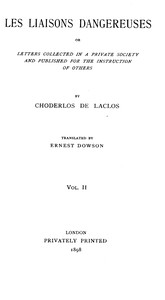
This digital edition of Les liaisons dangereuses, volume 2 (of 2) or, Letters collected in a private society and published for the instruction of others — Inside the Classic is described by source-level measurements including 77,973 words, 5 hr 40 min estimated reading time, and 90 detected text sections.
The text analysis averages about 21.9 words per sentence, while the detected sections provide another way to judge how the source is divided.
Project Gutenberg metadata also associates the work with “Epistolary fiction,” connecting these edition facts with the source record’s subject description.
Explore this collection
These alternatives are selected using recorded categories and estimated reading time.
About 324 minutes
Historical Psychological Social Fiction
74,379 recorded words. 16 minutes difference from this book's estimate.
View Gutenberg source #11128About 324 minutes
Historical Psychological Social Fiction
74,469 recorded words. 16 minutes difference from this book's estimate.
View Gutenberg source #46801About 366 minutes
Historical Psychological Social Fiction
83,956 recorded words. 26 minutes difference from this book's estimate.
View Gutenberg source #13882Search stored excerpts and compare books → Choose by your preferences →
Choices use stored catalog measurements. Estimates vary with reading speed. A shared category is a catalog label, not a claim that two books have the same argument or literary quality.
Search reads excerpt text stored with this catalog and links to its associated Gutenberg record. The connection is stored in the site database; this tool does not recheck that every excerpt is word-for-word identical to that external record. Excerpt search does not cover every chapter and does not verify historical publication dates.
Catalog snapshot checked: 2026-09-25. Coverage: 100 public books, 100 available source excerpts.
Read the complete public-domain text at its original source.
Read on Project GutenbergThe second volume of Les liaisons dangereuses opens with Valmont reporting to Merteuil that his campaign against the Présidente de Tourvel has reached a critical stage. His language oscillates between predatory satisfaction and theatrical impatience: he describes his own actions as a “charm” that requires a “reward,” and he addresses Merteuil as “my angel” while pressing her to dismiss her current lovers. The letter establishes a pattern of reciprocal manipulation that runs through the volume—each character writes to control how others perceive events, and the reader must weigh every claim against the speaker's interests.
Valmont's letters in this volume reveal a carefully calibrated voice that shifts between intimacy and command. To Tourvel he adopts a tone of wounded sincerity; to Merteuil he boasts of his progress with a mixture of gallantry and calculation. In Letter C, he writes that “the idea of her never left me” and that he must “make an effort in order to distract myself”—a confession that undercuts his pose of detached mastery. The translation by Ernest Dowson preserves these tonal shifts: Valmont's prose can be florid when he performs devotion, clipped when he issues orders to his servant Azolan, and slyly ironic when he reminds Merteuil of their pact. The reader observes a man who treats language as a weapon, yet whose own phrases sometimes betray genuine entanglement.
The Marquise de Merteuil writes fewer letters in this volume, but her influence pervades the correspondence. She receives reports, issues instructions, and orchestrates social consequences from a distance. In Letter CVI she chides Valmont for his impatience, and her tone is that of a director correcting an actor. Her language is precise, analytical, and devoid of the emotional excess that marks other correspondents. When she writes of Prévan's punishment—that he was “cruelly punished for a sin which he did not commit”—she frames it as a triumph of her own design. Merteuil's letters function as a counterweight to Valmont's narrative, reminding the reader that the libertine project is a collaboration, and that her control is exercised through the very act of writing.
Madame de Tourvel's letters to Madame de Rosemonde reveal a woman struggling to reconcile her religious principles with her feelings for Valmont. In Letter CXIV she describes her state as one of “sorrow” and “dread,” yet she continues to correspond with him. Her diction is marked by self-reproach and a desire for moral clarity: she speaks of “remorse for crime and contempt of yourself” as the alternatives to her current anguish. Madame de Rosemonde's replies adopt the metaphor of illness and convalescence, advising Tourvel to see herself as a patient recovering from a dangerous malady. The exchange highlights the gap between the libertines' calculated rhetoric and the genuine distress of a woman caught in their game.
Ernest Dowson's 1898 translation renders Laclos's French into an English that is both formal and pointed. He preserves the epistolary structure and the varying registers of the characters: Valmont's letters are often elaborate, Merteuil's are coolly precise, and Tourvel's are agitated. Dowson occasionally uses archaic constructions (“methinks,” “hasten then”) that give the text a period flavor, but he also captures the sharpness of Laclos's dialogue. The translation does not modernize the language, which means that the reader encounters the novel as a late-Victorian production—a version that emphasizes the psychological realism of the original while adding a layer of fin-de-siècle elegance. This edition thus offers a specific historical reading experience, distinct from more recent translations.
Readers approaching this volume should attend to the gaps between what characters say and what they conceal. The letters are performances, and the drama lies in the discrepancies between private confession and public assertion. Dowson's translation rewards careful reading of tone and word choice, as the smallest phrase can signal a shift in power. The novel's structure—a collection of letters with no narrator—leaves the reader to judge each voice without authorial guidance, a challenge that remains as engaging as when the book first appeared.
Reading Valmont’s letters to Tourvel, I remembered sitting on my grandmother’s porch, turning pages of Les Misérables, v. 1/5: Fantine — Edition Insights while the light thinned. Both books carry this ache of people maneuvering around each other, never quite saying the true thing. I kept imagining Fantine’s quiet despair, and here, Tourvel’s similar blindness. That tenderness gets crushed so slowly, so politely. It stays with you.
Save your reaction, strongest insight, and memorable passage.