About 258 minutes
Auriol; or, The Elixir of Life — Edition Insights
Historical Psychological Social Fiction
59,284 recorded words. 3 minutes difference from this book's estimate.
View Gutenberg source #36481
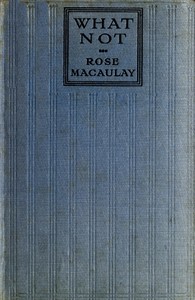
The source record for What Not: A Prophetic Comedy — Edition Insights measures this digital text at 60,024 words, 4 hr 21 min estimated reading time, and 6 detected text sections.
The text analysis averages about 18.0 words per sentence, while the detected sections provide another way to judge how the source is divided.
Project Gutenberg metadata also associates the work with “Science fiction,” connecting these edition facts with the source record’s subject description.
Explore this collection
These alternatives are selected using recorded categories and estimated reading time.
About 258 minutes
Historical Psychological Social Fiction
59,284 recorded words. 3 minutes difference from this book's estimate.
View Gutenberg source #36481About 248 minutes
Historical Psychological Social Fiction
56,998 recorded words. 13 minutes difference from this book's estimate.
View Gutenberg source #61262About 283 minutes
Historical Psychological Social Fiction
65,013 recorded words. 22 minutes difference from this book's estimate.
View Gutenberg source #58820Search stored excerpts and compare books → Choose by your preferences →
Choices use stored catalog measurements. Estimates vary with reading speed. A shared category is a catalog label, not a claim that two books have the same argument or literary quality.
Search reads excerpt text stored with this catalog and links to its associated Gutenberg record. The connection is stored in the site database; this tool does not recheck that every excerpt is word-for-word identical to that external record. Excerpt search does not cover every chapter and does not verify historical publication dates.
Catalog snapshot checked: 2026-09-25. Coverage: 100 public books, 100 available source excerpts.
Read the complete public-domain text at its original source.
Read on Project GutenbergRose Macaulay's What Not: A Prophetic Comedy opens with a note that the book was written during the war and delayed by legal alteration, framing its satire as a prophecy 'not yet disproved.' The novel's diction oscillates between bureaucratic jargon and ironic asides, as when Kitty reflects on 'First Brains, to perceive and know what things we ought to do, then Power, faithfully to fulfil the same.' This pairing of abstract ideals with mundane office life establishes a central tension.
The excerpts reveal a narrator who treats government absurdities with dry amusement: the 'Stop It' paper thrives on ambiguity, and Kitty's engagement letters go unsent because Neil Desmond lacks 'force.' Macaulay's voice is precise, layering social commentary through details like the 'thin foreign envelope' or the office's 'flat, dream-like look of arrested activity.'
Macaulay's word choices blend officialese with colloquial wit. The Ministry is personified as 'Dora,' a nickname that deflates authority. Phrases like 'just and temperate manner' are undercut by the context of suppression. Kitty's internal monologue uses formal constructions—'First Brains, to perceive… then Power'—mimicking bureaucratic logic while exposing its emptiness. The narrator's irony is consistent: the 'Stop It' paper succeeds by not committing to any statement, a joke that relies on the reader recognizing the absurdity of censorship. Macaulay avoids direct polemic, instead letting the language of committees and circulars reveal their own contradictions.
Dialogue in the excerpts is sparse but telling. The Minister's phone call—'Mr. Prideaux there? Or anyone else in his room I can speak to?'—is marked as 'unusual, hardly seemly,' highlighting the breach of protocol. Kitty's thoughts dominate, rendered in free indirect style: 'Force. How important it was.' This technique merges her voice with the narrator's, creating a layered perspective. When she reads 'something cold, soothing, remote from life as now lived, like Aristophanes, Racine, or Bernard Shaw,' the list itself is a wry comment on escapism. Macaulay uses voice to show how characters internalize the system's language, even as they critique it.
The novel's structure in the excerpts moves between Kitty's private reflections and the public space of the office. The lunch-hour suspension is described as a moment when 'you may decipher its silent, patient, cynical comment'—a pause that reveals the machinery of work. Macaulay juxtaposes Kitty's personal dilemmas (breaking an engagement) with national concerns (suppression of dissent). The office is both a literal setting and a symbol: its 'arrested activity' mirrors the stasis of a society governed by 'What Not.' The narrative rhythm alternates between Kitty's jaded mornings and the absurd events of her day, building a cumulative satire.
Small, repeated details anchor the satire. The 'thin foreign envelope' of Neil's letter contrasts with the bureaucratic thickness of office memos. Kitty's cigarette after stamping a letter is a gesture of defiance. The 'Stop It' paper, with its ambiguous command, recurs as a motif for the government's inability to define its own targets. Macaulay also uses the epigraphs—from Ecclesiasticus and a food-hoarding case—to frame the novel's concerns with wisdom, interference, and 'domestickness of spirit.' These details are not decorative; they build a texture of everyday life under a regime of control, where even reading Aristophanes becomes an act of resistance.
Readers should attend to how Macaulay's prose shifts between registers—from the lofty 'prophetic comedy' to the mundane 'What Not' of the title. The novel rewards attention to its verbal precision: a single adjective can carry a page of critique. Because the excerpts are incomplete, the full arc of Kitty's story remains unknown, but the authorial choices in diction, voice, and structure offer a coherent satirical method. This is a work that asks to be read slowly, with an ear for its irony and a eye for its bureaucratic absurdities.
There’s something tender in Kitty’s struggle—wanting order yet craving a life beyond it. I think of that same queasy pull in Auriol; or, The Elixir of Life — Edition Insights, where time itself becomes a kind of bureaucracy. Reading both feels like remembering a quieter argument I once had with myself about permanence.
Save your reaction, strongest insight, and memorable passage.