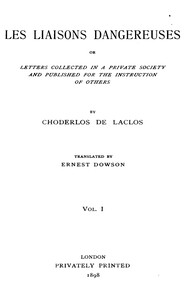
The first volume of Les liaisons dangereuses unfolds through a series of letters that shift between private confessions and calculated performances. One of the most striking features is the way the epistolary form itself becomes a tool of seduction and manipulation. In Letter LII, the Vicomte de Valmont writes to the Présidente de Tourvel, weaving a rhetoric of suffering and devotion that blurs the line between genuine emotion and strategic appeal. The letter's structure—moving from complaint to defense to a demand for a positive reply—reveals a pattern of psychological pressure that recurs throughout the volume.
The Architecture of the Letter
Each letter in this volume is a carefully constructed performance. Valmont's letter to Madame de Tourvel exemplifies this: it opens with a direct address to her prohibition, then builds a series of rhetorical questions that force her to imagine his suffering. The paragraph breaks mark shifts in tone—from lament to accusation to a plea for a 'positive' response. This structure mirrors the larger movement of the correspondence, where letters are not merely exchanged but strategically timed and composed to elicit specific reactions. The translator, Ernest Dowson, preserves the formal elegance of Laclos's prose, with long, balanced sentences that convey both the speaker's passion and his control.
Recurring Images of Exile and Tears
Valmont describes himself as living in 'exile' and 'languishing' under Madame de Tourvel's indifference. The image of tears—'the tears you cause to flow'—appears repeatedly, not as spontaneous emotion but as a calculated display. This motif of enforced separation and emotional suffering is not unique to Valmont; other correspondents in the volume also frame their desires in terms of distance and longing. The physical spaces of the letters—Paris, the countryside, the 'exile' imposed by Tourvel—become metaphors for the power dynamics at play. The reader is invited to observe how these images are deployed to manipulate sympathy and guilt.
Movement Between Intimacy and Distance
The epistolary form creates a peculiar tension: the letter is an intimate object, meant to be read in private, yet it also serves as a barrier between the correspondents. In Valmont's letter, he laments that he is 'living away from you' even as he writes to her. This paradox—the simultaneous presence and absence of the other—is central to the volume's structure. The letters often refer to previous letters, creating a chain of responses that build a shared history while also highlighting the gaps in understanding. The reader is placed in the position of an eavesdropper, privy to confessions that the characters themselves may not fully comprehend.
The Rhetoric of Self-Defense
Valmont's letter includes a lengthy self-defense against accusations of frivolity and deceit. He argues that his past behavior was a result of youth and the 'vortex' of society, and he offers Madame de Tourvel herself as a 'guarantee' of his sincerity. This move—turning the beloved into a witness for his character—is a sophisticated rhetorical strategy. It shifts the burden of proof onto her, asking her to 'question yourself in all good faith.' The volume contains several such moments where characters attempt to control how they are perceived through the very act of writing. The reader must weigh these self-portraits against the evidence of other letters, which often reveal contradictions.
Readers of this first volume should attend to the gaps between what characters say and what they do, as well as the way the letter form allows for both confession and concealment. The volume's structure—a sequence of letters that build on one another—creates a cumulative portrait of desire and manipulation. The translator's note from 1898 reminds us that this work has been seen as both a moral warning and a manual of seduction; the reader is left to decide which reading the letters themselves support.
I remember sitting with this volume, tracing Valmont’s calculated tears, and it brought back the ache of reading about Charles’s exile — that same hollow distance between what people write and what they truly feel. Bonnie Prince Charlie : a Tale of Fontenoy and Culloden — Inside the Classic once left me lingering on a single line about a letter never sent, and somehow that stillness feels familiar here.