About 248 minutes
Poirot Investigates — Key Ideas to Explore
Historical Psychological Social Fiction
56,998 recorded words. 99 minutes difference from this book's estimate.
View Gutenberg source #61262
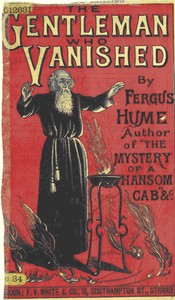
The catalog record for The Gentleman Who Vanished: A Psychological Phantasy — A Reader’s Guide provides practical reading context through 34,248 words, 2 hr 29 min estimated reading time, and 5 detected text sections.
The text analysis averages about 22.6 words per sentence, while the detected sections provide another way to judge how the source is divided.
Project Gutenberg metadata also associates the work with “England -- Fiction,” connecting these edition facts with the source record’s subject description.
Explore this collection
These alternatives are selected using recorded categories and estimated reading time.
About 248 minutes
Historical Psychological Social Fiction
56,998 recorded words. 99 minutes difference from this book's estimate.
View Gutenberg source #61262About 46 minutes
Historical Psychological Social Fiction
10,401 recorded words. 103 minutes difference from this book's estimate.
View Gutenberg source #32832About 42 minutes
Historical Psychological Social Fiction
9,460 recorded words. 107 minutes difference from this book's estimate.
View Gutenberg source #58670Search stored excerpts and compare books → Choose by your preferences →
Choices use stored catalog measurements. Estimates vary with reading speed. A shared category is a catalog label, not a claim that two books have the same argument or literary quality.
Search reads excerpt text stored with this catalog and links to its associated Gutenberg record. The connection is stored in the site database; this tool does not recheck that every excerpt is word-for-word identical to that external record. Excerpt search does not cover every chapter and does not verify historical publication dates.
Catalog snapshot checked: 2026-09-25. Coverage: 100 public books, 100 available source excerpts.
Read the complete public-domain text at its original source.
Read on Project GutenbergThe novel opens on an oppressively hot June night in London, with the air 'surcharged with electricity' and thunder rolling overhead. Two young men play cards in a bachelor's room off Piccadilly, oblivious to the storm—a scene that immediately establishes a tension between interior and exterior worlds. The weather is not mere backdrop: it mirrors the psychological pressure that will drive the plot. Hume's prose dwells on the 'ghost-like' lightning and the 'sordid souls' of the crowd, hinting at unseen forces that soon become literal.
The central conceit—a man's soul displaced from his body—is introduced through careful structural choices. Adrian Lancaster, after a card-game quarrel, believes he has killed Philip Trevanna and flees. But the narrative soon reveals a 'strange transformation': Adrian's consciousness inhabits another man's body. The excerpt shows him 'coiled as if he had received a blow' and unable to 'produce his own body'. Hume uses the physical to dramatize the psychological: the protagonist is literally out of step with himself. The reader experiences this dislocation through abrupt shifts in perspective and dialogue that force us to question who is speaking.
Throughout the excerpts, oppressive weather recurs as a structuring image. The opening 'heavy still atmosphere' returns in later scenes, where characters feel 'crushed down' by unseen pressures. The card room's open balcony offers no relief; the 'sultry air' penetrates even the handsomely furnished room. This claustrophobia extends to the country house setting, where Olive speaks of Adrian's 'hiding' and 'concealment'. Hume links physical environment to emotional state: the storm never fully breaks, just as the mystery remains unresolved. The heat becomes a metaphor for the characters' trapped circumstances, a detail that rewards close attention.
The conversation between Olive and the disguised Adrian (posing as Dr. Roversmire) is a masterclass in dramatic irony. Olive defends Adrian's character, calling him 'warm, impulsive and hot-tempered' while the real Adrian listens, unable to reveal himself. Hume uses clipped exchanges and Olive's 'vibrating voice' to heighten tension. When she says 'it ill becomes you to speak in this way', the reader feels the gap between what she knows and what she says. The dialogue does not just advance plot—it exposes the characters' inner conflicts. Adrian's internal thoughts ('Thank God... my character will be cleared') contrast sharply with his measured public replies, creating a layered portrait of a man split between two selves.
Hume experiments with first-person and third-person narration to destabilize the reader's sense of truth. The protagonist's own thoughts are presented as 'flashing rapidly through his brain', yet he cannot trust his perceptions. The novel's subtitle, 'A Psychological Phantasy', signals that the fantastic elements are grounded in mental states. The excerpt where Adrian 'resolved to gain time by dexterously temporising' shows him constructing a false identity even as he struggles to understand his own. This self-conscious performance—playing a role while being oneself—is the book's central structural device. The reader is left to piece together what is real from a narrative that deliberately blurs the line between inner and outer worlds.
Readers should attend to how Hume uses setting and weather as active participants in the drama, not mere decoration. The card game that triggers the plot is a microcosm of the larger game of identity being played. Pay particular attention to moments when characters observe themselves from outside—these are the novel's most revealing passages. The story rewards those who read slowly, noting how each scene's physical details echo the psychological state of its characters.
Rereading Fergus Hume’s feverish mirror-tricks, I kept thinking of that quiet woods elsewhere. The London heat and the card-game’s strange slippage felt less like plot than like a slow, uneasy breathing—the same way another story hums beneath its own surface. That other tale waits in Piper in the Woods — Background and Themes, and I found myself lingering there, half-remembering Hume’s shifting reflections. Odd, how two worlds can share one ache.
Your answers remain private and are stored only in this browser.