About 39 minutes
Pick a Crime — Inside the Classic
Historical Psychological Social Fiction
8,927 recorded words. 3 minutes difference from this book's estimate.
View Gutenberg source #51656
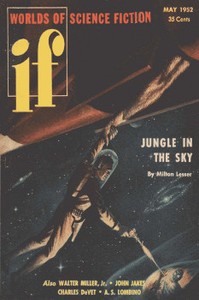
The source record for Dreamer's World — A Reader’s Guide measures this digital text at 9,460 words, 42 min estimated reading time, and 1 detected text section.
The text analysis averages about 11.6 words per sentence, while the detected sections provide another way to judge how the source is divided.
Project Gutenberg metadata also associates the work with “Science fiction,” connecting these edition facts with the source record’s subject description.
Explore this collection
These alternatives are selected using recorded categories and estimated reading time.
About 39 minutes
Historical Psychological Social Fiction
8,927 recorded words. 3 minutes difference from this book's estimate.
View Gutenberg source #51656About 46 minutes
Historical Psychological Social Fiction
10,401 recorded words. 4 minutes difference from this book's estimate.
View Gutenberg source #32832About 149 minutes
Historical Psychological Social Fiction
34,248 recorded words. 107 minutes difference from this book's estimate.
View Gutenberg source #55417Search stored excerpts and compare books → Choose by your preferences →
Choices use stored catalog measurements. Estimates vary with reading speed. A shared category is a catalog label, not a claim that two books have the same argument or literary quality.
Search reads excerpt text stored with this catalog and links to its associated Gutenberg record. The connection is stored in the site database; this tool does not recheck that every excerpt is word-for-word identical to that external record. Excerpt search does not cover every chapter and does not verify historical publication dates.
Catalog snapshot checked: 2026-09-25. Coverage: 100 public books, 100 available source excerpts.
Read the complete public-domain text at its original source.
Read on Project GutenbergBryce Walton's Dreamer's World opens with a warning hum and a man named Greg staring at a three-dim screen, his face crawling with perspiration. The story immediately establishes a world where consciousness itself is a burden: Greg has endured seventy-two hours of 'reality' without anesthesia, a span he finds 'boring, drab, dreary and revolting.' The narrative voice is taut, almost claustrophobic, matching the psychological pressure on its protagonist. Walton builds tension through small, precise details—the slide of a hand toward a warning button, the 'accusative, sad eyes' of Pat Nichols—rather than broad exposition. The setting is sketched lightly: a Cowl (apparently a sheltered community), an Outside, and a planned Venusian colony. But the real landscape is internal, as Greg weighs the comfort of induced sleep against the terror of waking choice.
The story repeatedly questions what sanity means in a society that pathologizes waking life. Greg's internal monologue treats consciousness as a kind of affliction: he marvels that he has 'remained sane' after seventy-two hours without anesthesia. Pat, by contrast, is labeled 'psycho' for rejecting the dream state and choosing the 'dreadful Outside.' The narrative does not endorse either position. Instead, it dramatizes the tension through Greg's physical reactions—his 'kind of panic,' his 'ill' feeling, his 'teeth clacking like an ancient abacus.' When he finally acts, he frames it as 'let yourself go insane.' The word 'insane' becomes a slippery label, applied to both the desire to escape and the willingness to engage with reality.
Walton's most striking imagery appears in the circular chamber where Pat is trapped. The walls are 'sagging and undulating like part of a giant's flesh,' with 'masses of the gray viscous stuff' that 'remolded itself into monstrous shapes.' This is not a mechanical or sterile threat but a visceral, almost digestive one: the walls 'closed around' Pat, and Greg sees 'husks' of previous victims 'sucked dry and shriveled.' The language is deliberately nauseating—'globules of paste,' 'shapeless tendrils,' 'steam and sickening stench.' The horror is not just physical but psychological: the walls seem alive, and Greg's own body responds with involuntary twitching, a 'volcano of madness.' The setting becomes an externalized version of his internal conflict.
The climax hinges on Greg's hand gripping a heat-blaster, his finger 'frozen on the firing stud.' He believes that if he destroys the creature, he is insane. Yet Pat's plea—'kill it, Greg. For me—Kill it'—overrides his conditioning. The act of destruction is described with a kind of terrible release: 'the gun had weight and power in his hand,' and he moves in 'kicking out to right and left.' The narrative does not celebrate this violence; it is framed as a 'great and terrible cry of torture.' Afterward, Greg apologizes for waiting too long, for not letting himself 'go insane' sooner. The weapon, then, is not a tool of heroism but a symbol of the cost of engagement. Walton leaves the reader to decide whether Greg's action is salvation or surrender.
Readers should pay close attention to the story's opening and closing frames: the warning hum and the fading image of Pat. Walton uses these bookends to suggest a loop or a dream-within-a-dream structure, though the excerpts do not confirm whether the entire narrative is a dream. The story rewards attention to its sensory details—the feel of perspiration, the sound of clacking teeth, the smell of steam—which ground its psychological abstractions in physical experience. Approach Dreamer's World as a tight, ambiguous meditation on what it means to choose reality, and what that choice costs.
There’s a particular exhaustion in Greg’s dreamless sleep that reminds me of putting down a heavy book late at night—the relief, and the quiet guilt. I found myself thinking of that strange limbo while flipping through John Thorndyke's Cases related by Christopher Jervis and edited by R. Austin Freeman — Edition Insights, where every answer arrives through careful, waking attention. Different worlds, but both ask what we choose when closing our eyes feels easier.
Save your reaction, strongest insight, and memorable passage.