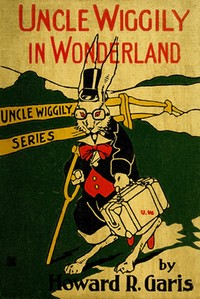
Howard R. Garis’s Uncle Wiggily in Wonderland opens not with a rabbit hole but with a pile of dishes. The bunny gentleman, dodging his housekeeper Nurse Jane, enlists Alice and the Do-do bird—whose tail must be pinched to make him work—to finish the chores. This domestic frame immediately distinguishes the book from its Carrollian source: Wonderland characters are imported as helpers and obstacles in Uncle Wiggily’s everyday world.
The structure follows a pattern: each chapter introduces a new Wonderland figure (the March Hare, Cheshire Cat, Mock Turtle) who either aids or complicates Uncle Wiggily’s tasks. Recurring images—the red, white and blue striped rheumatism crutch, the trumpet vine telephone, the skillery-scalery alligator—anchor the fantasy in a consistent, cozy setting. Movement between scenes often hinges on the alligator’s pursuit, creating a chase rhythm that propels the episodic narrative.
The Do-do’s Tail and the Work of Wonderland
In the opening chapter, the Do-do bird’s tail becomes a mechanical lever for labor: Alice pinches it to make him wash dishes, make beds, and sweep. Uncle Wiggily improves the system by substituting Nurse Jane’s hair curlers, which “keep pinching on it, and pinching on it all the while,” freeing him to walk with Alice. This invention—a self-pinching device—epitomizes the book’s blend of domestic ingenuity and absurdity. The Do-do “loved to do dishes,” a detail that transforms a Carrollian nonsense creature into a willing servant. The tail-pinching recurs as a structural device: it allows Uncle Wiggily to offload work and embark on adventures, while keeping the Wonderland visitor tethered to the bungalow. The image of the curlers snapping on the bird’s tail is one of several moments where Garis repurposes everyday objects (hair curlers, a cake of soap as a gun) into Wonderland mechanics.
The Alligator’s Pursuit and the Rhythm of Escape
The skillery-scalery alligator appears in multiple chapters as a persistent antagonist, always “out walking in the fields” or lurking near the muddy river. His dialogue with Mr. Spider in Chapter XVII reveals a pattern: he has tried every way to catch Uncle Wiggily, but “something always happens” because Alice or her friends intervene. This chase structure gives the episodic chapters a forward momentum. The alligator’s short name, “’gator, though he was rather long,” is a typical Garis pun, and his encounters often end with a narrow escape or a clever trick. The recurrence of this villain creates a through-line amid the rotating cast of Wonderland characters. Unlike the original Alice’s dreamlike transitions, Uncle Wiggily’s movements are motivated by the need to evade capture, grounding the fantasy in a simple survival logic.
Domestic Objects as Wonderland Props
Garis consistently transforms household items into tools of adventure. The trumpet vine telephone connects Uncle Wiggily to Mrs. Wibblewobble; the cake of soap becomes a “gun” for charging dishes; hair curlers become automatic tail-pinchers. The bungalow itself—the “hollow stump bungalow”—is both a home and a stage for Wonderland intrusions. Alice arrives while Uncle Wiggily is washing dishes, and the Do-do bird performs housework. This domestic setting contrasts with the original Wonderland’s outdoor, chaotic spaces. Even the alligator’s muddy river is a familiar landscape. The book’s illustrations by Edward Bloomfield likely reinforced this cozy visual world. By placing Wonderland figures in a context of chores and routines, Garis makes the absurd practical: the Cheshire Cat might appear during sweeping, the Hatter during tea-making. The result is a Wonderland that is less a dreamscape than a neighborhood.
Movement Between Scenes: Chapter Titles as a Map
The twenty-six chapter titles follow a consistent formula: “Uncle Wiggily and the [Wonderland character].” This structure promises a new encounter each chapter, but the narrative movement is not always linear. Characters from both Alice’s Adventures in Wonderland and Through the Looking-Glass appear—March Hare, Cheshire Cat, Dormouse, Gryphon, Caterpillar, Hatter, Duchess, Mock Turtle, Father William, Humpty Dumpty, Tweedledum and Tweedledee, and both Queens. The order does not mirror Carroll’s books; instead, Garis selects and sequences them for variety. The alligator’s pursuit provides a secondary thread that occasionally crosses paths with the Wonderland visitors. The final chapters introduce the Looking-Glass world, expanding the setting. This episodic movement, with each chapter a self-contained vignette, suits the bedtime-story format advertised on the title page. The repetition of “Uncle Wiggily and” in every heading reinforces the bunny as the fixed point around which Wonderland revolves.
Readers familiar with Lewis Carroll will notice that Garis borrows names and traits but reshapes them for a younger, more domestically oriented audience. The alligator’s pursuit and the Do-do’s tail-pinching are original inventions that give the book its own rhythm. Pay attention to how everyday objects—hair curlers, a cake of soap, a trumpet vine—become the machinery of adventure. The episodic structure makes this suitable for reading aloud one chapter at a time, each ending with a promise of the next encounter.
There’s something tender about Uncle Wiggily letting Alice’s friends help with his chores—the absurdity softened by kindness. It reminded me of quiet afternoons with A flower book — Context and Discussion, where even simple petals seem to hold their own gentle logic. I suppose that’s the comfort of it all.