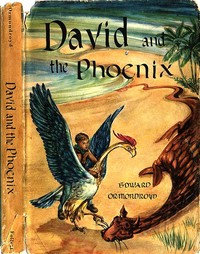
David's first sight of the mountain is the book's defining moment: he saves the experience, refusing to peek until the car stops, then stands in the back yard with eyes fixed on the ground before daring to look up. The mountain is described as 'infinitely more grand' than his father's description, and David feels it smiles at him like an old friend. This personal, almost mystical connection sets the tone for the encounters that follow.
The catalog subjects list 'Fantasy literature' and 'Phoenix (Mythical bird) -- Juvenile fiction,' but the excerpts show the phoenix as a practical, slightly pompous creature more concerned with proverbs and plans than mythic grandeur. The story's humor emerges from this contrast: the phoenix stumbles out of a thicket rubbing its eyes, complains about cookie quantities, and sketches trap diagrams in the dirt.
A Mountain That Whispers
The opening chapter establishes the mountain as a character in its own right. David hears a voice whispering 'Come along, then, and climb'—not from the phoenix but from the peak itself. The hedge in the back yard has grown 'right across the toes of the mountain,' blurring the boundary between domestic and wild. This detail, mentioned in passing, reinforces how the fantastic intrudes into ordinary life.
The mountain's scale is emphasized through David's physical reactions: he feels 'so tight and shivery inside' that he doesn't know whether to laugh or cry. The text avoids generic wonder by grounding the experience in specific sensations—clenched hands, a held breath, eyes fixed on the ground. Later, when the phoenix appears, the mountain becomes a stage for practical problems: hiding from a Scientist, constructing snares, and planning nocturnal adventures.
The Phoenix as Educator and Schemer
The phoenix in these excerpts is less a mythical wonder than a fussy tutor with a taste for cookies. It insists on David's 'education'—a word that appears in chapter titles and dialogue—but the lessons involve visiting gryffins, a sea monster, and a banshee. The phoenix's plans are elaborate and gadget-driven: rope, hatchet, electric doorbell, wire, and pushbutton are purchased for a snare system based on the Scientist's 'fixed habits.'
The humor lies in the phoenix's self-importance. It announces 'The Plan is far too profound for you to guess,' then sketches a diagram in the dirt. It quotes proverbs ('Never put off until tomorrow what can be done today') but immediately delays for cookies. David's frustration is palpable—'I can't make heads or tails out of it'—and the phoenix's triumphant reveal ('We shall sleep during the day and continue your education at night!') is both anticlimactic and endearing.
Threats and Tangible Dangers
The Scientist is a persistent offstage threat, described only through his habits: 'a daytime creature' who 'comes at dawn and goes at dusk.' He has ordered a new gun, and David worries it might arrive 'any time now.' This concrete detail—a mail-order rifle—makes the danger feel immediate and mundane, not magical. The phoenix's countermeasures are equally practical: snares, ropes, and a bell system.
The excerpts show David taking initiative, spending his ten-dollar farewell gift from Uncle Charles on supplies instead of a model airplane. The gold pieces from pirate treasure (mentioned in passing) are kept tied in a handkerchief. These small financial decisions ground the adventure in a child's reality: limited resources, secret stashes, and the weight of a ten-dollar bill.
Readers should pay attention to the chapter titles, which promise 'alarums and excursions' and hint at the episodic structure. The phoenix's education plan is not explained all at once; it unfolds through visits to mythological creatures, each with its own comic logic. The excerpts suggest a story that balances wonder with wit, where a boy's first mountain becomes the backdrop for a friendship built on cookies, proverbs, and elaborate traps.
That rainy afternoon, David’s first mountain kept me company while thunder rolled outside, and I found myself thinking about childhood’s strange, sudden loneliness—how a friend can appear from nowhere, feathered or not. Later, I drifted to The Poor Little Rich Girl — Reading Notes, and the same quiet ache was there, behind her golden cage.