About 104 minutes
The Scarlet Plague — Inside the Classic
Machines Inventions Early Science Fiction
23,869 recorded words. 8 minutes difference from this book's estimate.
View Gutenberg source #21970
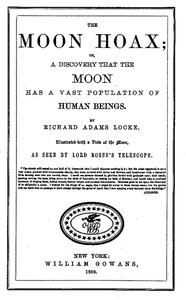
The source record for The moon hoax — Reading Companion measures this digital text at 25,739 words, 1 hr 52 min estimated reading time, and 3 detected text sections.
The text analysis averages about 29.5 words per sentence, while the detected sections provide another way to judge how the source is divided.
Project Gutenberg metadata also associates the work with “Science fiction,” connecting these edition facts with the source record’s subject description.
Explore this collection
These alternatives are selected using recorded categories and estimated reading time.
About 104 minutes
Machines Inventions Early Science Fiction
23,869 recorded words. 8 minutes difference from this book's estimate.
View Gutenberg source #21970About 69 minutes
Machines Inventions Early Science Fiction
15,673 recorded words. 43 minutes difference from this book's estimate.
View Gutenberg source #72277About 67 minutes
Machines Inventions Early Science Fiction
15,410 recorded words. 45 minutes difference from this book's estimate.
View Gutenberg source #51651Search stored excerpts and compare books → Choose by your preferences →
Choices use stored catalog measurements. Estimates vary with reading speed. A shared category is a catalog label, not a claim that two books have the same argument or literary quality.
Search reads excerpt text stored with this catalog and links to its associated Gutenberg record. The connection is stored in the site database; this tool does not recheck that every excerpt is word-for-word identical to that external record. Excerpt search does not cover every chapter and does not verify historical publication dates.
Catalog snapshot checked: 2026-09-25. Coverage: 100 public books, 100 available source excerpts.
Read the complete public-domain text at its original source.
Read on Project GutenbergThe Moon Hoax, first serialized in 1835, presents itself as a sober report of astronomical discoveries made by Sir John Herschel at the Cape of Good Hope. Its opening pages include an advertisement that compares the work to Utopia and Gulliver's Travels, signaling a knowing play with genre. The text moves between technical descriptions of a colossal telescope and vivid scenes of lunar inhabitants—creatures with bat-like wings, engaged in conversation and bathing. This oscillation between scientific jargon and fantastical detail is the hoax's central mechanism.
The narrative leans heavily on the authority of named scientists and institutions. It invokes Herschel, La Place, and Mrs. Somerville, and includes a detailed account of the telescope's construction—its lens, mount, and magnifying power. The editor claims to have received private correspondence from a Dr. Grant, which he is permitted to publish only in part. This layered framing (editor, correspondent, scientist) creates a chain of testimony that mimics scholarly publication. The reader is invited to trust the instrument before the observer. The text even promises that Herschel's own forthcoming volumes will include certificates from colonial authorities and ministers. Such apparatuses are not incidental; they are the hoax's primary rhetorical strategy.
Three visual motifs recur across the excerpts. First, wings: the lunar beings possess Vespertilio-homo or man-bat wings, described as semi-transparent membranes with straight radii, under full volition. Second, water: the creatures are seen bathing, crossing lakes, and lying on shores. Third, the landscape is named the Ruby Colosseum, a valley bounded by precipices two thousand feet high. These images are repeated with slight variation—wings spread and closed, water crossed, the Colosseum named twice. The repetition builds a coherent visual world while the pseudo-scientific naming (Ruby Colosseum, Bay of Rainbows) lends it a cartographic specificity. The effect is a landscape that feels mapped, not imagined.
The narrative progresses by shifting the telescope's aim. The observer moves from the valley to the Bay of Rainbows, then to Petavius, each transition marked by a pause in observation. The creatures are first seen from a distance, then closer, then in intimate detail—their feet, hands, gesticulation. The text mimics the act of focusing: “The next view we obtained of them was still more favorable.” This stepwise revelation creates suspense. The reader is positioned as a viewer, not a participant. The editor even withholds certain passages, promising they will appear in Herschel's book. This deferred disclosure is a structural device that keeps the hoax alive across installments.
The lunar beings are described as rational—they converse, gesticulate, and produce works of art. Yet their amusements “would but ill comport with our terrestrial notions of decorum.” The text simultaneously asserts their intelligence and their innocence, a combination that allows the hoax to titillate without moral condemnation. The beings are compared to ducks shaking off water, and their wings are described with anatomical precision. This blend of the scientific and the pastoral (fruits, flowers, fountains) echoes the Addison epigraph that opens the book. The hoax does not merely invent; it borrows the language of natural history and travel writing to make the fantastic seem plausible.
Readers approaching The Moon Hoax today will find its pleasure in the tension between credulity and skepticism. The text rewards attention to its structural tricks: the nested narrators, the repeated visual motifs, the careful pacing of revelation. It is less a story about the moon than a demonstration of how scientific authority can be manufactured. The hoax works because it looks and sounds like the thing it imitates.
I remember lying in bed as a kid, half-convinced the craters were cities. That same thrill of being fooled returned here, with Locke’s bat-winged figures peering through a telescope. But the quieter feeling came back—the ache of wanting to believe. From outer space — Reading Notes once held that same hush, that gentle line between wonder and doubt.
Build a private reading journal entry for this title.









