About 67 minutes
Conditionally Human — A Reader’s Guide
Machines Inventions Early Science Fiction
15,410 recorded words. 2 minutes difference from this book's estimate.
View Gutenberg source #51651
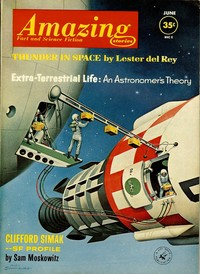
The source record for Thunder in space — Edition Insights measures this digital text at 15,673 words, 1 hr 9 min estimated reading time, and 2 detected text sections.
The text analysis averages about 15.4 words per sentence, while the detected sections provide another way to judge how the source is divided.
Project Gutenberg metadata also associates the work with “Science fiction,” connecting these edition facts with the source record’s subject description.
Explore this collection
These alternatives are selected using recorded categories and estimated reading time.
About 67 minutes
Machines Inventions Early Science Fiction
15,410 recorded words. 2 minutes difference from this book's estimate.
View Gutenberg source #51651About 57 minutes
Machines Inventions Early Science Fiction
13,054 recorded words. 12 minutes difference from this book's estimate.
View Gutenberg source #67292About 48 minutes
Machines Inventions Early Science Fiction
10,877 recorded words. 21 minutes difference from this book's estimate.
View Gutenberg source #23534Search stored excerpts and compare books → Choose by your preferences →
Choices use stored catalog measurements. Estimates vary with reading speed. A shared category is a catalog label, not a claim that two books have the same argument or literary quality.
Search reads excerpt text stored with this catalog and links to its associated Gutenberg record. The connection is stored in the site database; this tool does not recheck that every excerpt is word-for-word identical to that external record. Excerpt search does not cover every chapter and does not verify historical publication dates.
Catalog snapshot checked: 2026-09-25. Coverage: 100 public books, 100 available source excerpts.
Read the complete public-domain text at its original source.
Read on Project GutenbergThe story opens with a Geneva garden scene where the U.S. President and Soviet Premier acknowledge a stalemate, their heads turning to watch a space station—either American or Russian—pass overhead. The narrative voice is dry and ironic, noting that 'half the world lived in almost hysterical fear of one or the other.' This Cold War framing is reinforced by the station's name, Goddard or Tsiolkovsky, and the veto of a UN resolution to internationalize space.
The excerpts show a shift from diplomatic failure to a personal, technical mystery aboard the American station. The protagonist, Blane, observes that the Soviet station lacks bombs, and a female cosmonaut, Sonya Vartanian, seems to deliberately reveal this. The story's title 'Thunder' is used as a code word for trouble, a recurring detail that ties the space setting to Earth's storms.
The opening chapter establishes a grim diplomatic impasse. The President and Premier meet in a 'little formal garden' in Geneva, guarded but isolated. Their conversation reveals mutual constraints: the President risks impeachment, the Premier political suicide. The word 'thunder' appears early as a code for trouble, a term the station crew uses. The narrator comments that 'the phrases had long since lost all meaning' in propaganda, a wry observation on Cold War rhetoric.
The space station itself is a visible symbol of fear, described as 'sparkling in sunlight' but linked to 'hysterical fear' on Earth. The story does not specify which nation's station is overhead, emphasizing the symmetry of the superpowers. The UN resolution for internationalization is vetoed by both, showing the failure of multilateral solutions. This opening sets up the central tension: military competition in space versus the hidden reality of decaying warheads.
When Blane visits the Soviet station Tsiolkovsky, he notes its 'spaciousness and richness of equipment' compared to the cramped American Goddard. This detail, along with the Soviet station's better design for war, undercuts the official U.S. narrative of superior spirit. The female cosmonaut Sonya Vartanian leads Blane across the station three times, ensuring he sees the empty bomb bays. Blane deduces the warheads have been gone for two years, coinciding with a mass ship movement and an explosion.
The scientist Peal speculates that the Soviet warheads decayed earlier than America's, forcing secret disarmament. The story avoids direct confirmation, leaving the inference to the reader. The contrast between the stations' physical conditions and the political posturing is a key structural element, highlighting the gap between public rhetoric and private reality.
After the revelation, Blane returns to the Goddard and is immediately absorbed by routine: 'a new mountain of complaints and thunder-scripts.' The secretary barely notices his absence, underscoring the dehumanizing bureaucracy of the station. The narrative includes a satirical aside about a Congressman who uses the 'old American spirit' to justify underfunding space, while ignoring historical facts. This irony extends to the news from Earth, where Russia denies needing help and refuses political deals.
The story's tone is skeptical of official narratives, whether American or Soviet. Blane's fatigue and the station's cramped conditions contrast with the high-stakes mystery. The excerpts end with Blane listening to news, suggesting that the personal discovery of mutual disarmament will not easily translate into political change. The 'thunder' code word remains, now loaded with the irony that the real trouble is not war but the decay of weapons themselves.
The excerpts present a Cold War thriller that is more about mutual vulnerability than heroism. Readers should note how the story uses physical details—the garden, the stations' interiors, the repeated crossing of a room—to build a case for secret cooperation. The incomplete text leaves open whether Blane's theory is correct and how the political standoff resolves. Pay attention to the role of Sonya Vartanian, whose actions are crucial but whose motives remain ambiguous. The story rewards attention to small, concrete observations over grand pronouncements.
Reading about those cramped American stations and the spacious Soviet ones, I remembered my father’s old atlas, the one with a single reading lamp. It had a similar quiet ache for a truth hidden in plain sight. That same strange warmth, a sigh of relief for a story choosing peace over pride, met me again in Bring the Jubilee — Inside the Classic; it felt like watching history hold its breath, then finding a gentler path.
Save your reaction, strongest insight, and memorable passage.









