About 177 minutes
The eternal moment, and other stories — Context and Discussion
Young Readers Enchanted Adventures
40,585 recorded words. 14 minutes difference from this book's estimate.
View Gutenberg source #72890
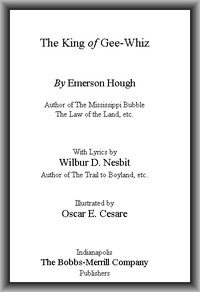
Before opening The King of Gee-Whiz — A Closer Reading, the edition data offers a quick orientation: 43,922 words, 3 hr 11 min estimated reading time, and 34 detected text sections.
The text analysis averages about 20.2 words per sentence, while the detected sections provide another way to judge how the source is divided.
Project Gutenberg metadata also associates the work with “Fantasy literature,” connecting these edition facts with the source record’s subject description.
Explore this collection
These alternatives are selected using recorded categories and estimated reading time.
About 177 minutes
Young Readers Enchanted Adventures
40,585 recorded words. 14 minutes difference from this book's estimate.
View Gutenberg source #72890About 206 minutes
Young Readers Enchanted Adventures
47,180 recorded words. 15 minutes difference from this book's estimate.
View Gutenberg source #14391About 207 minutes
Young Readers Enchanted Adventures
47,522 recorded words. 16 minutes difference from this book's estimate.
View Gutenberg source #35029Search stored excerpts and compare books → Choose by your preferences →
Choices use stored catalog measurements. Estimates vary with reading speed. A shared category is a catalog label, not a claim that two books have the same argument or literary quality.
Search reads excerpt text stored with this catalog and links to its associated Gutenberg record. The connection is stored in the site database; this tool does not recheck that every excerpt is word-for-word identical to that external record. Excerpt search does not cover every chapter and does not verify historical publication dates.
Catalog snapshot checked: 2026-09-25. Coverage: 100 public books, 100 available source excerpts.
Read the complete public-domain text at its original source.
Read on Project GutenbergEmerson Hough's The King of Gee-Whiz opens with a pair of twins whose most striking feature is not their blue eyes or rosy cheeks, but their hair: Zuzu has green hair, Lulu blue. This detail, introduced in the first chapter, immediately signals that the story operates in a world where the ordinary is tinged with the extraordinary. The twins' father, Aurelius Pickle, is a chemist, and the narrative quickly moves from domesticity to enchantment when a strange visitor arrives. The early chapters establish a pattern of mixing the mundane (a widow's household) with the fantastical (an enchanted banjo that speaks and sings). Readers should pay attention to how Hough uses the twins' hair as a marker of their special status, a motif that recurs throughout the excerpts.
The opening chapter explicitly states that Zuzu and Lulu's hair—green for the boy, blue for the girl—makes them "quite different from most twins." This is not merely a whimsical detail; it is tied to their identity as "Royal Hereditary Twins," a phrase that appears later when the enchanted banjo addresses them. The hair color is a visual shorthand for their uniqueness and foreshadows their royal lineage. In the excerpts, the banjo remarks that it is "very strange that Twins with Royal Hereditary Hair should not be able to see" a resting place, linking their physical trait to their destiny. Readers should note how this detail recurs and evolves, as it is central to the plot's logic.
A key element of the narrative is the enchanted banjo, which not only speaks but also plays songs with lyrics. The excerpt includes the full text of "The Jealous Jumping Jack," a poem about a toy that jumps away in rage. This song, like others in the book (e.g., "How the Birds Learn to Sing"), serves as a pause in the action and a commentary on the themes of jealousy and learning. The banjo's ability to play tunes that "had in it some strange things which they had not hitherto heard" suggests that the songs are not mere decoration but part of the magical world's logic. Readers should consider how these verses relate to the twins' journey and the moral lessons embedded in the story.
The twins' adventures involve a series of fantastical vehicles: the Gee-Whiz Submarine Express, the Bumblebee Express, and the Golden Ladder. The excerpts show them climbing the Golden Ladder, which hangs suspended in a rocky chasm, and carrying a dragon's leg. The ladder leads to a cave where they rest and eat lunch. The narrative emphasizes the difficulty of reaching fairy realms: "it shows how very hard it always is to get into the secret places where the Fairies live." This pattern of travel—by air, water, and ladder—structures the plot and introduces new settings like Candy-Town and the Valley of Gold. Readers should track how each mode of transport reflects the whimsical yet rule-bound nature of the fairy world.
In the excerpts, Zuzu carries a dragon's leg, a burden he eventually questions: "I don't see why I carried it at all, for when one stops to reason it out, there seems very little use in the wooden leg of a Dragon for any one but the Dragon itself." This moment of self-awareness is typical of the story's tone, where characters occasionally step back to reflect on the absurdity of their quest. The dragon's leg is one of several objects (the gold waffle-iron, the rubber tree) that appear in the chapter titles and likely serve as plot devices. Readers should note how these items are introduced and whether they prove useful later, as the narrative often rewards attention to such details.
As you read The King of Gee-Whiz, pay attention to the interplay between prose and verse, and how the songs comment on the action. The twins' hair color is a clue to their heritage, and the enchanted banjo is both companion and guide. The story's structure—moving from one fantastical location to another—mirrors a journey of discovery, but the excerpts suggest that the real adventure lies in the characters' growing understanding of their own roles. Approach the book as a series of linked episodes, each with its own logic and charm.
Reading about Zuzu and Lulu’s odd green and blue hair, I remembered sitting on my grandmother’s porch, feeling equally strange and wonderful. That same quiet awe washed over me later with Rootabaga Stories — Key Ideas to Explore, where the moon’s laundry lines and popcorn villages felt less like fantasy and more like a secret language we both somehow spoke.
Build a private reading journal entry for this title.









