About 40 minutes
The Golden Judge — Background and Themes
Machines Inventions Early Science Fiction
9,189 recorded words. 2 minutes difference from this book's estimate.
View Gutenberg source #24495
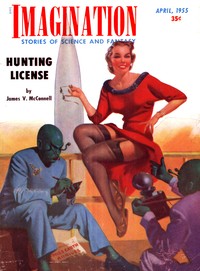
This digital edition of Hunting License — Context and Discussion is described by source-level measurements including 8,626 words, 38 min estimated reading time, and 1 detected text section.
The text analysis averages about 13.5 words per sentence, while the detected sections provide another way to judge how the source is divided.
Project Gutenberg metadata also associates the work with “Science fiction,” connecting these edition facts with the source record’s subject description.
Explore this collection
These alternatives are selected using recorded categories and estimated reading time.
About 40 minutes
Machines Inventions Early Science Fiction
9,189 recorded words. 2 minutes difference from this book's estimate.
View Gutenberg source #24495About 40 minutes
Machines Inventions Early Science Fiction
9,112 recorded words. 2 minutes difference from this book's estimate.
View Gutenberg source #67364About 41 minutes
Machines Inventions Early Science Fiction
9,258 recorded words. 3 minutes difference from this book's estimate.
View Gutenberg source #65070Search stored excerpts and compare books → Choose by your preferences →
Choices use stored catalog measurements. Estimates vary with reading speed. A shared category is a catalog label, not a claim that two books have the same argument or literary quality.
Search reads excerpt text stored with this catalog and links to its associated Gutenberg record. The connection is stored in the site database; this tool does not recheck that every excerpt is word-for-word identical to that external record. Excerpt search does not cover every chapter and does not verify historical publication dates.
Catalog snapshot checked: 2026-09-25. Coverage: 100 public books, 100 available source excerpts.
Read the complete public-domain text at its original source.
Read on Project GutenbergThe story opens not with a chase but with a leisurely campfire conversation. William Karsten III and Thomas Thurman discuss helicopters overhead and the absence of their guide, Emmett, with the mundane irritation of vacationers. The hunting jackets, collapsible chairs, and coffee container establish a domesticated wilderness—a game preserve enclosed by a tall metal fence. The dialogue reveals their primary anxiety: that the quarry might be too ordinary. Thurman hopes the criminal is not 'just an ordinary criminal,' and Karsten worries about the luck of shooting a woman first thing. The hunt is framed as sport, with the prey's suffering reduced to a matter of trophy quality.
The narrative voice maintains a clinical distance from the violence it describes. The helicopters are 'fat flies,' the fence is a 'stout circle of steel,' and the hunters refer to their prey as 'it' until they glimpse the color of its stripes. The dialogue is filled with euphemisms: 'trophies,' 'black stripes,' 'subversive.' When Karsten worries about getting airsick, Thurman's concern is purely pragmatic—'They don't hunt very well when they're sick.' This language transforms a manhunt into a sporting event, stripping the quarry of humanity. The author never uses the word 'victim' or 'prisoner'; the criminal is always 'game' or 'quarry.' Even the guide's role is reduced to logistics: 'What's the sense of hiring a hunting guide if he's not around to take care of things for you?'
The story's pace shifts markedly between the opening campfire scene and the pursuit. The early paragraphs are slow, filled with idle chatter and the ritual of coffee-making. Once the chase begins, the prose accelerates: sentences shorten, action verbs dominate, and the hunters' breathing becomes part of the rhythm. 'They plunged into the heavy forest only a few hundred yards behind their game. Following rapidly along behind him, they left a wake of broken branches and torn limbs as they went.' The narrative tracks the quarry by sound—'the noise of his running'—and by fleeting glimpses: 'an arm, a leg, or part of his back.' The hunters' physical exertion is mirrored in the text's breathless clauses, culminating in the moment they corner their prey in a narrow pass between rocks.
The game preserve is described with deliberate ambiguity: it is a 'little forest clearing' with a fire, but also a 'stout circle of steel' that cuts it off from the world. The setting oscillates between pastoral and prison-like. The hunters navigate 'thick underbrush,' 'marsh land,' and 'berry bushes,' yet the fence is always visible. This duality reinforces the story's central irony: a natural landscape engineered for artificial sport. The quarry's path—through a 'narrow corridor' of rock into a 'little canyon'—suggests a trap, not a wilderness. The author uses setting to control pace: open ground allows quick glimpses, while dense forest forces the hunters to rely on sound. The final pass, 'not much more than ten feet wide,' funnels both hunter and hunted into an inevitable confrontation.
Readers should attend to how the story withholds the quarry's perspective entirely. The narrative never enters the mind of the hunted, maintaining the hunters' point of view throughout. This structural choice mirrors the dehumanization at the story's core. The excerpts offer no resolution—the chase ends at the pass—leaving the outcome uncertain. The story's power lies in its restraint: it does not moralize, but lets the clinical details speak for themselves.
Reading this, I remembered watching someone dismiss a caught fish by its stripe pattern, more concerned with the trophy than the struggle. It felt eerily familiar, that detachment. Another book, Task to Luna — Story, Setting & Ideas, once gave me that same quiet chill—not the action, but the casual table talk between worlds that made the marvel feel ordinary, even disposable.
Build a private reading journal entry for this title.









