L
Lisa Mays
Guest
- Thread Author
- #1
You're standing at the sink with a watering can in one hand and a packet of spikes in the other, wondering whether pushing one into the soil counts as feeding your plant for the season. It feels simpler than mixing liquid food, and that's exactly the appeal. But indoor plant food spikes aren't magic sticks. They're a localized nutrient source, and how well they work depends on your pot, your watering routine, and whether your plant is growing right now.
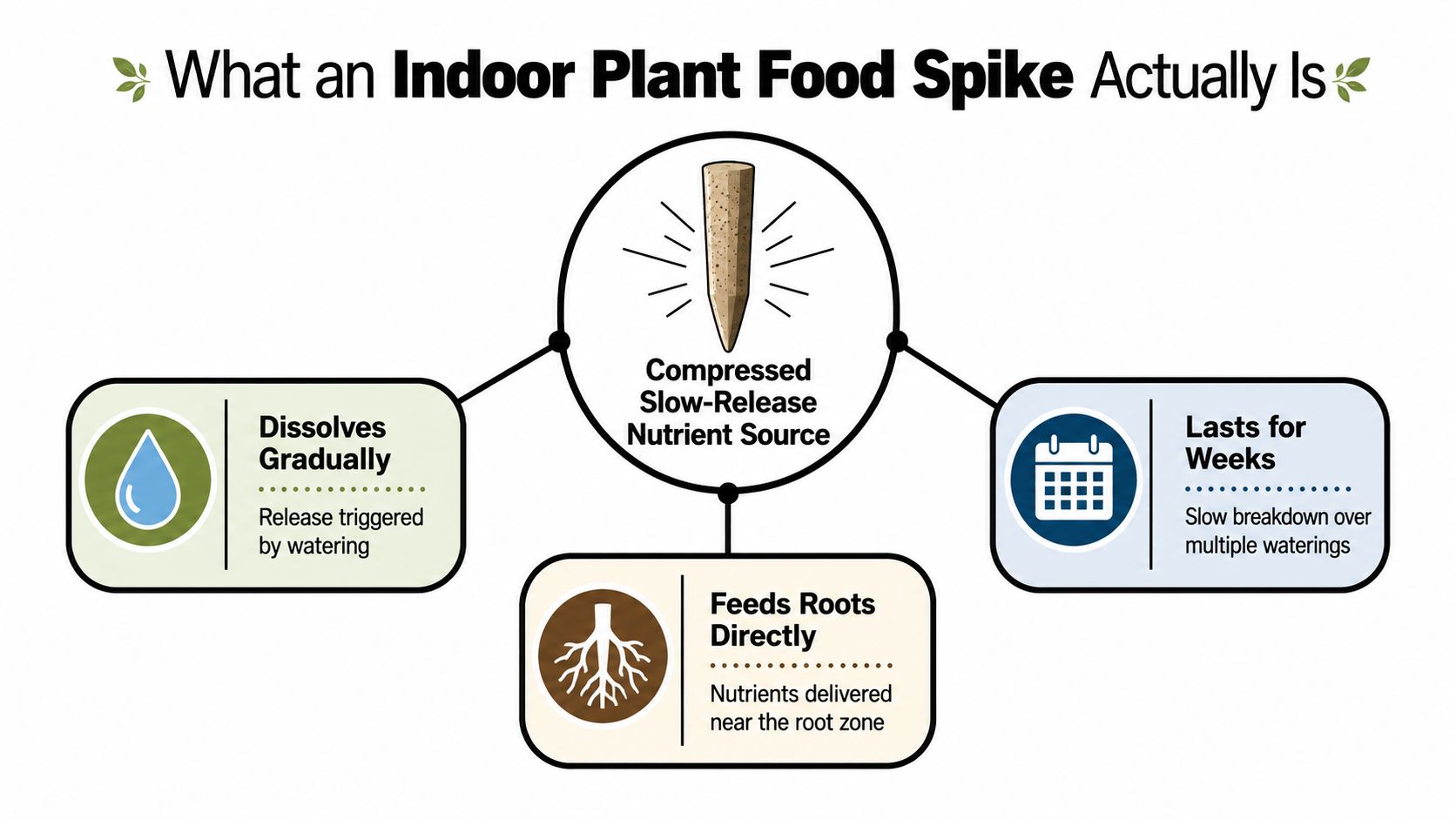
You're at your kitchen sink, spike between your fingers, watering can ready. Before you push it in, it helps to know what you're holding. A spike is a compressed slow-release nutrient source. Water moves into it during watering, dissolves some of the nutrients inside, and those nutrients gradually move into the surrounding soil near the root zone.
That's the whole mechanism. There's no separate spike chemistry. The format is a delivery convenience, built on the same controlled-release principle used in turf and agricultural products. What changes is the shape and concentration. Instead of spreading many small pellets across the surface or diluting food in water, you're placing the nutrients in one compact piece at one insertion point.
Three ideas will help you read any label without getting distracted by phrases like continuous feed or smart release.
Release duration varies widely by formulation and conditions. University of Florida guidance on slow-release fertilizer forms reports that pellet- or spike-form slow-release fertilizers may release nutrients over approximately 20 days to 18 months, depending on formulation, moisture, and temperature.
That distinction matters indoors. A pellet scattered across the surface creates many small release points. A tablet or spike concentrates release in fewer places. The nutrients themselves aren't automatically better or worse because of the shape. What changes is how evenly they reach roots, how often you apply them, and how much room you have for error in a small pot.
Modern indoor spikes look like a houseplant invention, but they came from a much older effort to stop nitrogen from becoming available all at once. Controlled-nitrogen-release products based on urea and formaldehyde were first produced in 1936 and reached commercialization in 1955, and by 1995 slow- and controlled-release fertilizers represented only about 0.15 percent of the fertilizer market, roughly 562,000 tons, according to the history of controlled-release fertiliser development.
That small market share tells an important story. Slow release was specialized technology, not the default way to feed plants. Manufacturers were solving a practical problem, making nutrients last longer and reducing how quickly they were lost or used up, but the products served particular uses rather than replacing conventional fertilizer everywhere.
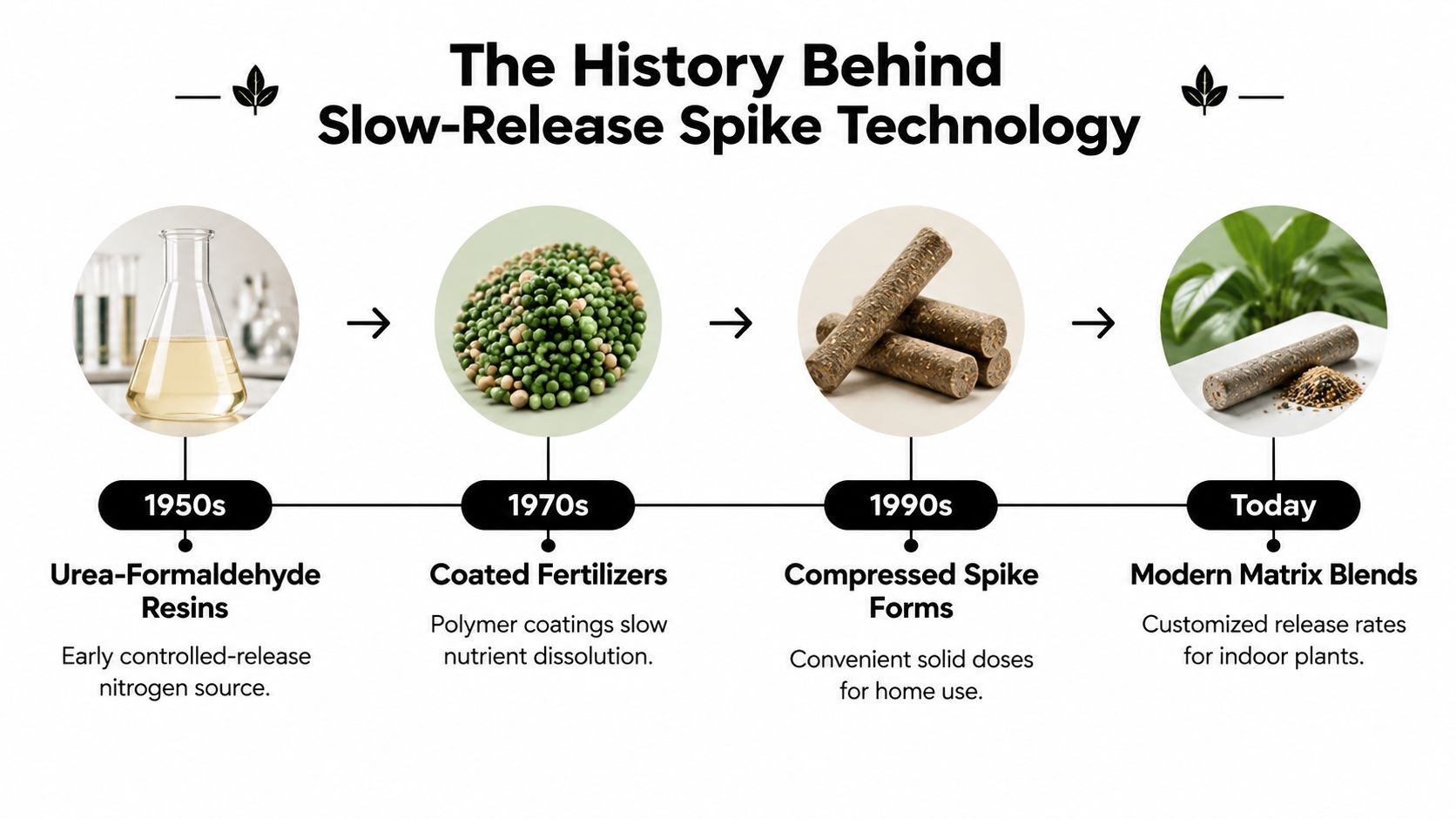
Early commercial urea-formaldehyde material contained much of its nitrogen in a cold-water-insoluble form, meaning it didn't dissolve immediately, with a smaller portion remaining quickly available. Methylene-urea products followed later, again balancing slower fractions against unreacted urea nitrogen that plants could access sooner. The details changed, but the design question stayed the same. How do you hold some nutrient back without holding it back forever?
Another route came through coatings. Workers at the Tennessee Valley Authority's National Fertilizer Development Center developed sulfur-coated urea, which slowed release by putting a physical barrier around the nutrient. Later controlled-release products refined that same idea with different coatings and matrices.
Compressed tablets and spikes are the convenience-oriented end of this story. They package gradual dissolution and diffusion into a solid piece you can insert without measuring liquid. Because manufacturers can vary the formulation, coating, and matrix, two products shaped alike can behave differently in the same pot.
That's why duration claims shouldn't be read as promises carved in stone. Release is engineered, but it's also environmental. Once you see spikes as descendants of decades of nutrient-release engineering, variable performance stops looking like a contradiction and starts looking like the expected result.
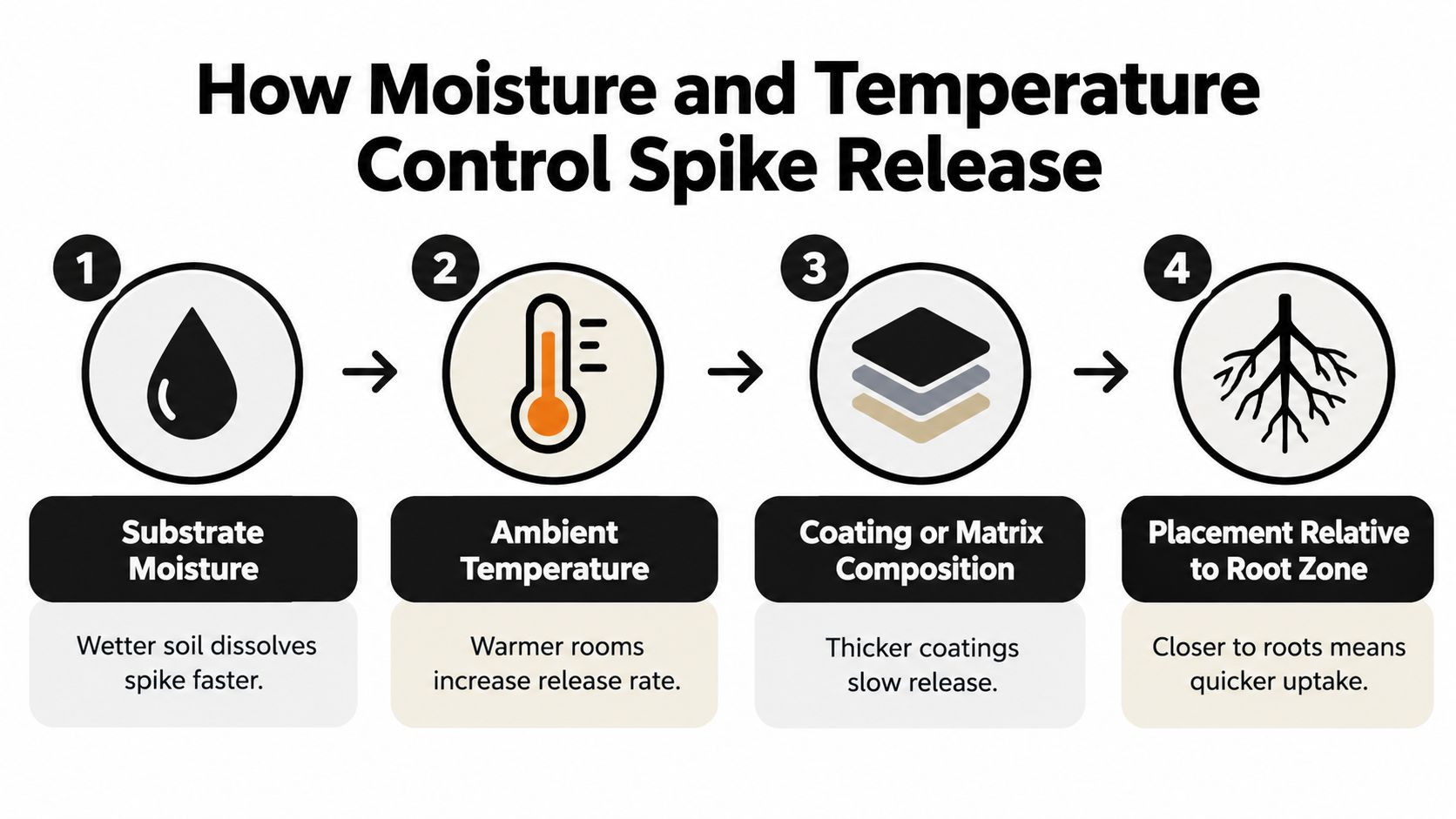
A spike doesn't release on a calendar. It responds to the conditions around it. Four levers matter most in a living room, and you control at least three of them every time you water or move a plant.
These levers explain a common frustration. You insert a spike, the plant still looks hungry, and you assume the product failed. In a cool room with restrained watering, nutrient delivery may be slow. The opposite happens too. Warmth plus consistently moist soil can move nutrients faster than you expected, shortening the useful feeding period and increasing the need to watch for excess.
Turf feeding intervals also don't translate neatly indoors. A lawn receives different light, temperature, rainfall, and root conditions from a container on a shelf. Most living rooms are more stable, and often cooler and drier, than outdoor turf. Use the package interval as a starting point, then check what's happening. New growth, leaf color, soil surface condition, and how quickly the mix dries tell you more than a generic schedule.
If your plant is in bright warmth and you water often, inspect it more frequently. If it's resting in low light and you water sparingly, don't add another spike just because the first one is still visible. Visibility isn't the same as nutrient availability, and adding more can turn slow delivery into a concentration problem once conditions change.
Choosing a fertilizer format is mostly choosing a distribution pattern. The nutrient numbers on the package matter, but in a container, where nutrients start and how they spread often decides whether feeding feels easy or troublesome. Spikes, liquids, pellets, and granules can all supply nutrients. They just ask different things of you.
Liquid fertilizer goes where the water goes. If you water thoroughly, it can reach much of the root zone in one application. That makes liquids easier to adjust. You can feed lightly, skip a feeding, or stop entirely when growth slows. The trade-off is work. You have to measure, mix, and remember.
Spikes trade that flexibility for convenience. You insert and water as usual, but you can't easily dial the dose down once release is underway. You also can't assume every root receives the same amount. If you're weighing that trade-off, a detailed comparison of liquid and pellet fertilizer formats can help clarify how application style changes control.
Pellets and spikes both promise slow release, so shoppers often treat them as interchangeable. They're not. Pellets divide the total dose into many pieces. Spikes keep much of it together. In a larger floor planter, that concentration may be diluted by a bigger root mass and soil volume. In a small container, one spike can dominate the space roots have available.
Granules sit somewhere between. Spread evenly, they cover more surface than a spike. Piled carelessly, they create their own hot spots. Storage differs too. Liquids need measuring tools and careful dilution, while dry formats are tidy but can tempt you to eyeball amounts.
Pick according to your watering style. If you're attentive and like control, liquid feeding fits. If you forget feedings but water reliably, pellets or carefully placed spikes may fit better. If your plant barely needs water, a spike's release will be tied to that sparse routine, and another format may be easier to judge. The best fit is the one whose release pattern matches the pot you have, not the routine you wish you had.
Start with the container, not the packet. Ask how much soil volume the roots occupy, whether the plant is actively growing, and how often you water. Those answers should shape the dose before you count spikes.
Washington State University guidance on houseplant fertilizer placement notes that spikes and tablets release nutrients laterally when the plant is watered, so placement affects how evenly nutrients reach containerized roots. Roots may also grow toward the concentrated zone, which can unbalance feeding across the pot.
If you want to sanity-check quantity before you apply anything, review how fertilizer application rates should change with container conditions and compare that logic with the spike label. For dry-loving plants especially, Cactus Outlet fertilizer advice is a useful reminder that application method and plant needs have to be considered together rather than treating every pot as identical.
During routine watering, glance at the soil surface and pot rim. You're looking for white crust, slowed growth, or leaf edge damage that suggests salts are building up. Don't wait for a dramatic decline. Small containers give you less buffer, so early observation is part of dosing, not an optional extra.
Slow release sounds gentle, and that's where many growers get misled. A spike can deliver nutrients steadily while the plant uses very few of them. When demand is low, even consistent delivery can become excess.
Indoor plants often grow more slowly than outdoor plants because light is limited and containers restrict roots. Excess fertilizer can accumulate as soluble salts, producing brown leaf margins, yellowing, wilting, stunting, leaf drop, or a white crust on soil and pot rims in containerized houseplants, as described in Iowa State University guidance on diagnosing houseplant problems from poor culture.
Symptoms overlap, so use context before you act.
For a fuller symptom check, compare what you're seeing with common signs of over-fertilizing container plants before you add anything else. The key question isn't only what's wrong with the leaves. It's what changed recently in light, watering, drainage, and feeding.
Stop feeding first. If the pot drains freely, flush it thoroughly with water so excess salts move out with the runoff. Then discard the runoff. Don't let the pot sit in it and reabsorb what you just removed.
For very small containers, flushing may not be enough if the spike occupies much of the root zone or the mix is heavily crusted. Repotting into fresh mix can be safer than repeatedly trying to dilute a concentrated source in a tiny volume. Remove a remaining spike if it's accessible and clearly part of the problem, but avoid tearing through roots to hunt for fragments.
Winter and low light deserve special caution. Reduced light and temperature slow growth, so nutrients accumulate instead of being used. Pausing isn't neglect. It's matching supply to demand, which is the entire skill behind successful container feeding.
No single answer fits every plant on your shelf. Root structure, pot size, watering rhythm, and growth timing change whether a spike is a sensible primary feed, an occasional supplement, or the wrong tool entirely.
University of Maryland Extension recommends fertilizing indoor plants mainly from March through September and notes that slow-release pellets commonly provide nutrients for roughly three to four months. Use that active-growth window as your frame, then adjust by plant group.
Fiddle leaf figs and larger foliage houseplants are usually the easiest fit. Their containers and root masses are often substantial enough to dilute a localized source better than a tiny pot can. During active growth, with reliable watering, a correctly placed spike can work as a convenience feed. Still watch for salt crust and uneven growth, especially if the plant sits in lower light than it prefers.
Bonsai need more caution. Trees are often grown in shallow containers with limited substrate, so a spike can occupy a meaningful share of the root zone. Localized feeding may look tidy, but precision matters more than tidiness here. A divisible pellet or carefully diluted liquid often gives you finer control, with spikes reserved only for situations where size and placement suit the container.
Succulents and cacti generally prefer leaner feeding. Their watering rhythm is sparse, which makes spike release harder to predict, and they may not need fertilizer outside their active spring and summer growth. If you feed, think lightly and seasonally. A set-and-forget spike can outlast the period when the plant wants nutrients, particularly in a small pot that dries and then gets soaked.
Orchids also call for restraint. Many are grown in open, fast-draining mixes where water moves quickly and roots are exposed to air as well as moisture. That structure doesn't distribute a concentrated insertion point the way a dense soil mix might. Salt sensitivity makes observation essential. For many orchid growers, a measurable liquid routine is easier to pause, dilute, or flush than a spike lodged in bark.
The pattern is consistent. Bigger, actively growing, regularly watered plants give you more margin for error. Small, shallow, dry-loving, or salt-sensitive plants give you less. Match the format to that margin, and indoor plant food spikes become a deliberate choice rather than a gamble.
If you're deciding whether spikes, pellets, or liquid food best match your containers, Leaves & Soul offers purpose-built soils and fertilizers for bonsai, fiddle leaf figs and other houseplants, succulents and cacti, and orchids. Visit to compare slow-release pellets, liquid plant foods, and targeted soil blends, then choose the format that fits your plant's pot size, watering rhythm, and active-growth season.
What an Indoor Plant Food Spike Actually Is
You're at your kitchen sink, spike between your fingers, watering can ready. Before you push it in, it helps to know what you're holding. A spike is a compressed slow-release nutrient source. Water moves into it during watering, dissolves some of the nutrients inside, and those nutrients gradually move into the surrounding soil near the root zone.
That's the whole mechanism. There's no separate spike chemistry. The format is a delivery convenience, built on the same controlled-release principle used in turf and agricultural products. What changes is the shape and concentration. Instead of spreading many small pellets across the surface or diluting food in water, you're placing the nutrients in one compact piece at one insertion point.
The vocabulary that matters on a package
Three ideas will help you read any label without getting distracted by phrases like continuous feed or smart release.
- Release duration: How long nutrients become available, not how long the spike remains visible. A spike can look intact while much of its readily available nutrient content has already moved out, or it can sit in dry soil releasing very little.
- Active growth: The period when light and temperature support new leaves, stems, or roots, and the plant is using nutrients.
- Root zone: The volume of soil or growing mix occupied by roots. In a container, that volume is limited, so one concentrated source can affect a large share of it.
Release duration varies widely by formulation and conditions. University of Florida guidance on slow-release fertilizer forms reports that pellet- or spike-form slow-release fertilizers may release nutrients over approximately 20 days to 18 months, depending on formulation, moisture, and temperature.
A spike is best understood as fertilizer placed in one spot and released gradually by watering, not as food that automatically knows what your plant needs.
That distinction matters indoors. A pellet scattered across the surface creates many small release points. A tablet or spike concentrates release in fewer places. The nutrients themselves aren't automatically better or worse because of the shape. What changes is how evenly they reach roots, how often you apply them, and how much room you have for error in a small pot.
The History Behind Slow-Release Spike Technology
Modern indoor spikes look like a houseplant invention, but they came from a much older effort to stop nitrogen from becoming available all at once. Controlled-nitrogen-release products based on urea and formaldehyde were first produced in 1936 and reached commercialization in 1955, and by 1995 slow- and controlled-release fertilizers represented only about 0.15 percent of the fertilizer market, roughly 562,000 tons, according to the history of controlled-release fertiliser development.
That small market share tells an important story. Slow release was specialized technology, not the default way to feed plants. Manufacturers were solving a practical problem, making nutrients last longer and reducing how quickly they were lost or used up, but the products served particular uses rather than replacing conventional fertilizer everywhere.
From reacted nitrogen to coated products
Early commercial urea-formaldehyde material contained much of its nitrogen in a cold-water-insoluble form, meaning it didn't dissolve immediately, with a smaller portion remaining quickly available. Methylene-urea products followed later, again balancing slower fractions against unreacted urea nitrogen that plants could access sooner. The details changed, but the design question stayed the same. How do you hold some nutrient back without holding it back forever?
Another route came through coatings. Workers at the Tennessee Valley Authority's National Fertilizer Development Center developed sulfur-coated urea, which slowed release by putting a physical barrier around the nutrient. Later controlled-release products refined that same idea with different coatings and matrices.
Why history explains confusing labels
Compressed tablets and spikes are the convenience-oriented end of this story. They package gradual dissolution and diffusion into a solid piece you can insert without measuring liquid. Because manufacturers can vary the formulation, coating, and matrix, two products shaped alike can behave differently in the same pot.
That's why duration claims shouldn't be read as promises carved in stone. Release is engineered, but it's also environmental. Once you see spikes as descendants of decades of nutrient-release engineering, variable performance stops looking like a contradiction and starts looking like the expected result.
How Moisture and Temperature Control Spike Release
A spike doesn't release on a calendar. It responds to the conditions around it. Four levers matter most in a living room, and you control at least three of them every time you water or move a plant.
The four levers in a real pot
- Substrate moisture: Water is the trigger. A frequently watered mix keeps dissolving and moving nutrients, while a mix that stays dry for long stretches slows that process down. This is why a thirsty foliage plant and a barely watered succulent shouldn't be expected to use the same spike at the same pace.
- Ambient temperature: Warmer conditions generally speed release, and cooler conditions slow it. A pot on a bright, warm windowsill lives in a different microclimate from a pot in a cool corner, even if both are in the same home.
- Coating or matrix composition: Manufacturers build delay into the product itself. A thicker coating or a denser compressed matrix can slow water entry and nutrient movement, while a more readily soluble formulation gives up nutrients sooner.
- Placement relative to roots: Nutrients start at the insertion point and spread from there. Roots close to the spike encounter a stronger concentration than roots on the far side of the container.
These levers explain a common frustration. You insert a spike, the plant still looks hungry, and you assume the product failed. In a cool room with restrained watering, nutrient delivery may be slow. The opposite happens too. Warmth plus consistently moist soil can move nutrients faster than you expected, shortening the useful feeding period and increasing the need to watch for excess.
Practical rule: Judge a spike by the pot's moisture and temperature pattern, not by the date alone.
Turf feeding intervals also don't translate neatly indoors. A lawn receives different light, temperature, rainfall, and root conditions from a container on a shelf. Most living rooms are more stable, and often cooler and drier, than outdoor turf. Use the package interval as a starting point, then check what's happening. New growth, leaf color, soil surface condition, and how quickly the mix dries tell you more than a generic schedule.
If your plant is in bright warmth and you water often, inspect it more frequently. If it's resting in low light and you water sparingly, don't add another spike just because the first one is still visible. Visibility isn't the same as nutrient availability, and adding more can turn slow delivery into a concentration problem once conditions change.
Spikes Compared With Liquids, Pellets, and Granules
Choosing a fertilizer format is mostly choosing a distribution pattern. The nutrient numbers on the package matter, but in a container, where nutrients start and how they spread often decides whether feeding feels easy or troublesome. Spikes, liquids, pellets, and granules can all supply nutrients. They just ask different things of you.
| Format | Distribution | Application frequency | Burn risk | Best fit |
|---|---|---|---|---|
| Spike | Concentrated at insertion point, spreading laterally with watering | Less frequent | Higher near the spike if overdosed or placed poorly | Larger, actively growing containers where convenience matters |
| Liquid | Broad, moves with applied water through the mix | More frequent | Depends on dilution and how often you apply | Plants needing flexible, adjustable feeding |
| Slow-release pellet | Many small points across the surface or mixed zone | Less frequent | Lower from any single pellet, but excess total dose still matters | Container plants wanting gradual feeding with wider coverage |
| Surface granule | Spread across surface, then moved by watering | Varies by product | Can concentrate if piled against stems or roots | Situations where surface application is practical and measurable |
Distribution is the real dividing line
Liquid fertilizer goes where the water goes. If you water thoroughly, it can reach much of the root zone in one application. That makes liquids easier to adjust. You can feed lightly, skip a feeding, or stop entirely when growth slows. The trade-off is work. You have to measure, mix, and remember.
Spikes trade that flexibility for convenience. You insert and water as usual, but you can't easily dial the dose down once release is underway. You also can't assume every root receives the same amount. If you're weighing that trade-off, a detailed comparison of liquid and pellet fertilizer formats can help clarify how application style changes control.
Why pellets and spikes get confused
Pellets and spikes both promise slow release, so shoppers often treat them as interchangeable. They're not. Pellets divide the total dose into many pieces. Spikes keep much of it together. In a larger floor planter, that concentration may be diluted by a bigger root mass and soil volume. In a small container, one spike can dominate the space roots have available.
Granules sit somewhere between. Spread evenly, they cover more surface than a spike. Piled carelessly, they create their own hot spots. Storage differs too. Liquids need measuring tools and careful dilution, while dry formats are tidy but can tempt you to eyeball amounts.
Pick according to your watering style. If you're attentive and like control, liquid feeding fits. If you forget feedings but water reliably, pellets or carefully placed spikes may fit better. If your plant barely needs water, a spike's release will be tied to that sparse routine, and another format may be easier to judge. The best fit is the one whose release pattern matches the pot you have, not the routine you wish you had.
How to Place and Dose Spikes Without Burning Roots
Start with the container, not the packet. Ask how much soil volume the roots occupy, whether the plant is actively growing, and how often you water. Those answers should shape the dose before you count spikes.
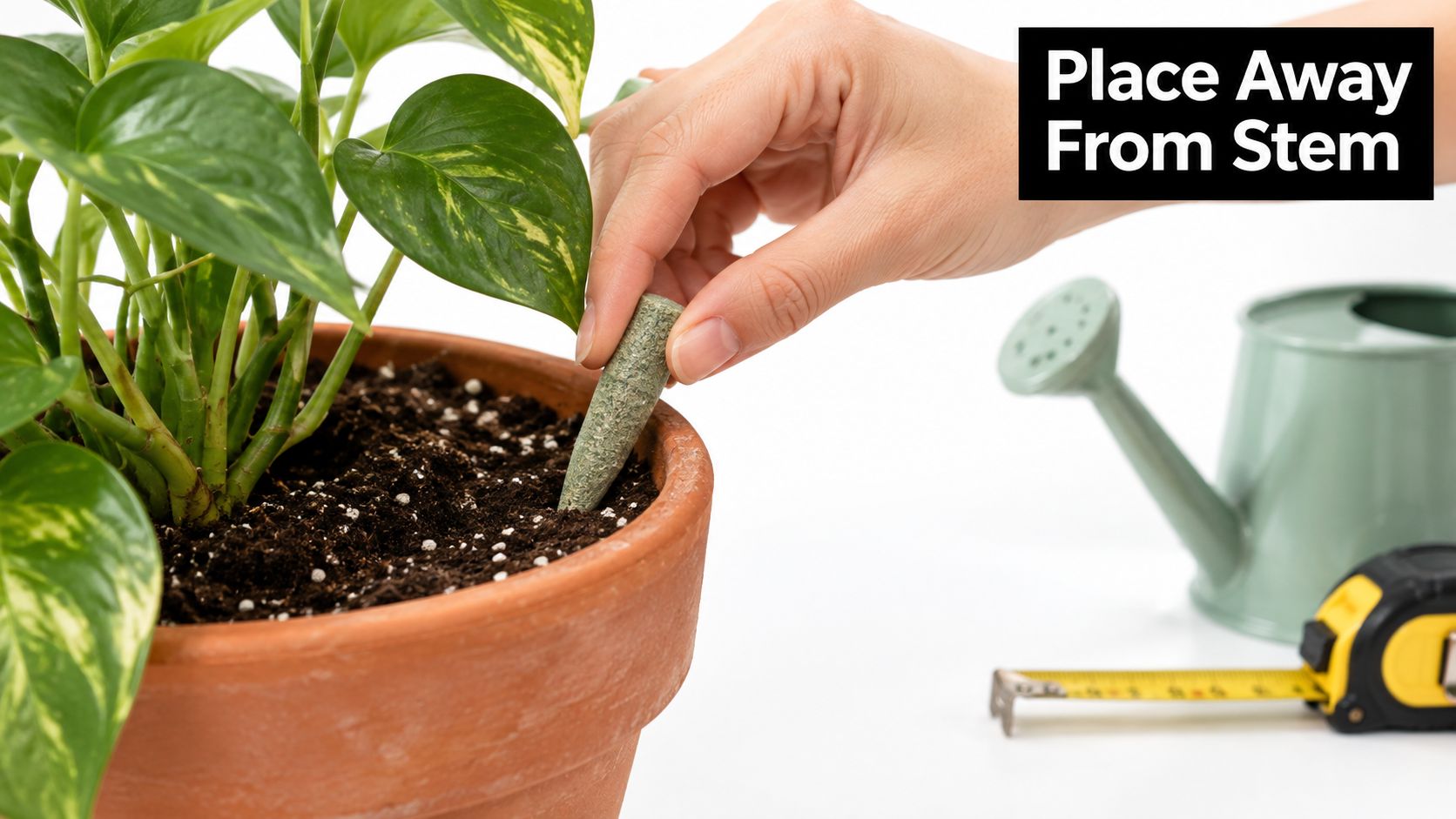
Washington State University guidance on houseplant fertilizer placement notes that spikes and tablets release nutrients laterally when the plant is watered, so placement affects how evenly nutrients reach containerized roots. Roots may also grow toward the concentrated zone, which can unbalance feeding across the pot.
A repeatable placement method
- Check active growth first: Feed when light and temperature support new growth. Pause when the plant is resting, stressed, or barely using water.
- Water the mix if it's very dry: Inserting into hard, dry substrate can damage roots and makes placement harder to judge. Follow the product directions for timing around watering.
- Keep distance from the stem: Place the spike in the root zone but not pressed against the main stem or trunk. You're aiming for access, not contact with the most sensitive point.
- Spread multiple spikes out: If the container calls for more than one, distribute them rather than clustering them. Clustering recreates the concentration problem you're trying to avoid.
- Reduce your confidence in small pots: A small bonsai container and a large floor planter shouldn't be treated identically. When in doubt, choose a more divisible format for very small containers instead of forcing a spike to fit.
- Log the insertion date: Write it on a plant label or in your phone. Memory is unreliable, and double feeding usually starts with forgetting.
If you want to sanity-check quantity before you apply anything, review how fertilizer application rates should change with container conditions and compare that logic with the spike label. For dry-loving plants especially, Cactus Outlet fertilizer advice is a useful reminder that application method and plant needs have to be considered together rather than treating every pot as identical.
During routine watering, glance at the soil surface and pot rim. You're looking for white crust, slowed growth, or leaf edge damage that suggests salts are building up. Don't wait for a dramatic decline. Small containers give you less buffer, so early observation is part of dosing, not an optional extra.
Reading the Warning Signs Before Salt Injury Sets In
Slow release sounds gentle, and that's where many growers get misled. A spike can deliver nutrients steadily while the plant uses very few of them. When demand is low, even consistent delivery can become excess.
Indoor plants often grow more slowly than outdoor plants because light is limited and containers restrict roots. Excess fertilizer can accumulate as soluble salts, producing brown leaf margins, yellowing, wilting, stunting, leaf drop, or a white crust on soil and pot rims in containerized houseplants, as described in Iowa State University guidance on diagnosing houseplant problems from poor culture.
Separate salt injury from look-alike problems
Symptoms overlap, so use context before you act.
- Salt injury is more likely when: You see white crust, brown margins, or stunting after feeding, especially if runoff is rarely discarded or the plant hasn't been growing actively.
- Underwatering is more likely when: The mix is dry through much of the pot, leaves wilt more uniformly, and the plant recovers promptly after thorough watering without a history of heavy feeding.
- Poor drainage or root rot is more likely when: The mix stays wet, stems soften, or decline continues despite the soil remaining moist. Adding fertilizer won't fix roots that can't function.
- Insufficient light is more likely when: Growth becomes leggy, new leaves stay small or pale, and the plant stretches toward a window while using water slowly.
For a fuller symptom check, compare what you're seeing with common signs of over-fertilizing container plants before you add anything else. The key question isn't only what's wrong with the leaves. It's what changed recently in light, watering, drainage, and feeding.
More consistent nutrient delivery can still be harmful when plant demand is low.
What to do when salts are the likely culprit
Stop feeding first. If the pot drains freely, flush it thoroughly with water so excess salts move out with the runoff. Then discard the runoff. Don't let the pot sit in it and reabsorb what you just removed.
For very small containers, flushing may not be enough if the spike occupies much of the root zone or the mix is heavily crusted. Repotting into fresh mix can be safer than repeatedly trying to dilute a concentrated source in a tiny volume. Remove a remaining spike if it's accessible and clearly part of the problem, but avoid tearing through roots to hunt for fragments.
Winter and low light deserve special caution. Reduced light and temperature slow growth, so nutrients accumulate instead of being used. Pausing isn't neglect. It's matching supply to demand, which is the entire skill behind successful container feeding.
Matching Spikes to Fiddle Leaf Figs, Bonsai, Succulents, and Orchids
No single answer fits every plant on your shelf. Root structure, pot size, watering rhythm, and growth timing change whether a spike is a sensible primary feed, an occasional supplement, or the wrong tool entirely.
University of Maryland Extension recommends fertilizing indoor plants mainly from March through September and notes that slow-release pellets commonly provide nutrients for roughly three to four months. Use that active-growth window as your frame, then adjust by plant group.
Four common fits
Fiddle leaf figs and larger foliage houseplants are usually the easiest fit. Their containers and root masses are often substantial enough to dilute a localized source better than a tiny pot can. During active growth, with reliable watering, a correctly placed spike can work as a convenience feed. Still watch for salt crust and uneven growth, especially if the plant sits in lower light than it prefers.
Bonsai need more caution. Trees are often grown in shallow containers with limited substrate, so a spike can occupy a meaningful share of the root zone. Localized feeding may look tidy, but precision matters more than tidiness here. A divisible pellet or carefully diluted liquid often gives you finer control, with spikes reserved only for situations where size and placement suit the container.
Succulents and cacti generally prefer leaner feeding. Their watering rhythm is sparse, which makes spike release harder to predict, and they may not need fertilizer outside their active spring and summer growth. If you feed, think lightly and seasonally. A set-and-forget spike can outlast the period when the plant wants nutrients, particularly in a small pot that dries and then gets soaked.
Orchids also call for restraint. Many are grown in open, fast-draining mixes where water moves quickly and roots are exposed to air as well as moisture. That structure doesn't distribute a concentrated insertion point the way a dense soil mix might. Salt sensitivity makes observation essential. For many orchid growers, a measurable liquid routine is easier to pause, dilute, or flush than a spike lodged in bark.
The pattern is consistent. Bigger, actively growing, regularly watered plants give you more margin for error. Small, shallow, dry-loving, or salt-sensitive plants give you less. Match the format to that margin, and indoor plant food spikes become a deliberate choice rather than a gamble.
If you're deciding whether spikes, pellets, or liquid food best match your containers, Leaves & Soul offers purpose-built soils and fertilizers for bonsai, fiddle leaf figs and other houseplants, succulents and cacti, and orchids. Visit to compare slow-release pellets, liquid plant foods, and targeted soil blends, then choose the format that fits your plant's pot size, watering rhythm, and active-growth season.