About 25 minutes
Project Hush — Text and Context
Machines Inventions Early Science Fiction
5,546 recorded words. 0 minutes difference from this book's estimate.
View Gutenberg source #32654
The catalog record for Two Weeks in August — Key Ideas to Explore provides practical reading context through 5,564 words, 25 min estimated reading time, and 1 detected text section.
The text analysis averages about 17.8 words per sentence, while the detected sections provide another way to judge how the source is divided.
Project Gutenberg metadata also associates the work with “Science fiction,” connecting these edition facts with the source record’s subject description.
Explore this collection
These alternatives are selected using recorded categories and estimated reading time.
About 25 minutes
Machines Inventions Early Science Fiction
5,546 recorded words. 0 minutes difference from this book's estimate.
View Gutenberg source #32654About 24 minutes
Machines Inventions Early Science Fiction
5,472 recorded words. 1 minutes difference from this book's estimate.
View Gutenberg source #32633About 21 minutes
Machines Inventions Early Science Fiction
4,687 recorded words. 4 minutes difference from this book's estimate.
View Gutenberg source #63949Search stored excerpts and compare books → Choose by your preferences →
Choices use stored catalog measurements. Estimates vary with reading speed. A shared category is a catalog label, not a claim that two books have the same argument or literary quality.
Search reads excerpt text stored with this catalog and links to its associated Gutenberg record. The connection is stored in the site database; this tool does not recheck that every excerpt is word-for-word identical to that external record. Excerpt search does not cover every chapter and does not verify historical publication dates.
Catalog snapshot checked: 2026-09-25. Coverage: 100 public books, 100 available source excerpts.
Read the complete public-domain text at its original source.
Read on Project GutenbergThe story opens with a detailed portrait of McCleary, an office colleague whose relentless one-upmanship grates on the narrator. The narrator's voice is colloquial and rueful, describing how McCleary's boasts about his children, car, and especially his vacations make everyone else feel inadequate. The vacation rivalry is the central tension: the narrator dreads returning from his modest two weeks in August only to hear McCleary's superior account, complete with photographs and souvenirs.
This setup, grounded in mundane office politics, takes a sharp turn when the narrator, stuck at home due to medical bills, discovers a peculiar travel agency. The catalog subjects list Mars and science fiction, but the excerpts show that the Martian element is introduced late and framed as a surprising, almost casual solution to the narrator's vacation envy.
The first half of the excerpt is devoted entirely to establishing McCleary as a type: the colleague who excels at making others feel small. The narrator's complaints are specific and relatable—McCleary's children are always smarter, his car always a better bargain, his vacations always more impressive. The prose uses direct address (“You could pack the wife and kids…”) and hyperbolic similes (“like a half-done hotdog at a barbecue”) to create a conspiratorial tone with the reader.
This rivalry is not just background; it motivates the entire plot. The narrator's fear of McCleary's pity drives him to seek an alternative to a staycation. The story's science-fiction element emerges only after this thoroughly established domestic frustration. The catalog subject “Vacations” is thus not a minor detail but the story's emotional core.
The transition from office gripe to space travel is abrupt. The narrator, resigned to a backyard vacation, stumbles upon a travel agency that offers trips to Mars. The excerpts do not reveal how the agency works or why it targets ordinary people, but the tone remains light and ironic. The narrator's voice stays consistent: he is still the same put-upon everyman, now faced with an absurdly grandiose option.
The story's structure thus mirrors its opening line: “The humblest events sometimes result from the most grandiose beginnings.” Here, the grandiose beginning is the space-travel premise, but the humblest event—a man trying to avoid his colleague's mockery—is what sets it in motion. The catalog subject “Mars (Planet) — Fiction” is accurate, but the excerpts suggest Mars is less a setting for exploration than a punchline to a workplace joke.
The narrator's language is firmly mid-century American: “Super-eight,” “Old Reliable,” “poor man's Sun Valley.” These details anchor the story in a specific era of car culture and modest vacations. The prose is conversational, with dashes and asides that mimic spoken storytelling. The illustrator Elizabeth MacIntyre's work is mentioned in the metadata but not described in the excerpts.
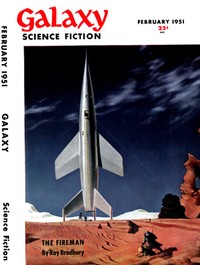
The story originally appeared in Galaxy Science Fiction in 1951, a context that explains its blend of domestic realism and speculative twist. The catalog subject “Science fiction” fits, but the story's emphasis on character and complaint over technology or alien encounters may surprise readers expecting hard SF. The excerpts end with the narrator learning that Martian vacations are “not very well advertised yet,” leaving the resolution—and whether he actually goes—unstated.
The excerpts provide only the story's setup and a hint of its payoff. Readers should note that the narrator's voice is the story's main attraction: his grievances are funny, his desperation relatable, and his encounter with the fantastic is treated with the same wry disbelief he brings to McCleary's boasts. The catalog subjects accurately reflect the story's ingredients, but the proportions matter more—this is a character piece with a science-fiction garnish, not the reverse.
After finishing Two Weeks in August, I kept thinking about how the narrator’s quiet ache for something more never really left me—even after the silly Mars escape. It reminded me of another story with that same tender undercurrent, That Sweet Little Old Lady — A Closer Reading, where the loneliness hides beneath such gentle, everyday details. That feeling stayed with me long after the last page.
Save your reaction, strongest insight, and memorable passage.









