
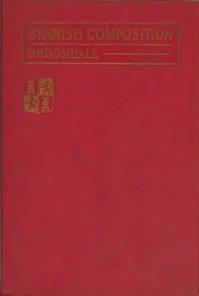
Spanish Composition by Edith J. Broomhall
Let's be clear from the start: 'Spanish Composition' is a textbook. Published in 1910, it was designed for English-speaking students to practice writing in Spanish. There are no characters, no plot twists, and no dramatic climax. Instead, you get exercises, vocabulary lists, and sample sentences. Edith J. Broomhall was a teacher, and her goal was practical: to help students construct correct sentences.
The Story
There isn't a story in the traditional sense. The 'narrative' is the progression of lessons. It starts with fundamentals like articles and nouns ('el libro', 'la mesa') and builds up to more complex tenses and sentence structures. The content of the practice sentences is what's fascinating. Students translate sentences about taking trains, visiting cathedrals, writing letters home, and describing family life. It paints a very specific, orderly picture of early 20th-century life—one centered on travel, polite society, and classical education.
Why You Should Read It
You read this book for the atmosphere, not the action. It's a direct line to a classroom over a century ago. The Spanish it teaches is formal and a bit old-fashioned. More than that, the worldview embedded in the exercises is strikingly innocent. It assumes a stable, predictable world where the biggest challenge is correctly using the subjunctive mood. As a modern reader, you can't help but overlay the history you know—the World Wars, the Spanish Civil War, massive social change—onto these calm exercises. That contrast is powerful. It turns a simple language guide into a poignant artifact. Broomhall wasn't trying to be profound; she was trying to be useful. But in doing her job well, she accidentally preserved the tone and priorities of her era.
Final Verdict
This isn't for everyone. If you're looking for a page-turner, look elsewhere. But if you're a history lover, a language nerd, or someone who finds beauty in everyday artifacts from the past, this is a hidden gem. It's perfect for readers who enjoy 'slow' non-fiction, social history, or unique primary sources. You won't get a thrilling tale, but you will get a quiet, compelling hour inside the mind of the Edwardian era. Just be prepared—it might make you think about all the ordinary textbooks of our own time and what they will say about us to readers in 2124.
This content is free to share and distribute. Thank you for supporting open literature.
Deborah Williams
8 months agoIf you enjoy this genre, the clarity of the writing makes this accessible. Thanks for sharing this review.
Mark Perez
1 year agoBeautifully written.
Emily Thomas
1 year agoHonestly, it manages to explain difficult concepts in plain English. This story will stay with me.
Jackson King
1 year agoAfter hearing about this author multiple times, the author's voice is distinct and makes complex topics easy to digest. Absolutely essential reading.
Ava Scott
8 months agoWithout a doubt, the author's voice is distinct and makes complex topics easy to digest. Definitely a 5-star read.