About 35 minutes
Guaranteed—Forever! — Inside the Classic
Machines Inventions Early Science Fiction
7,923 recorded words. 1 minutes difference from this book's estimate.
View Gutenberg source #66138
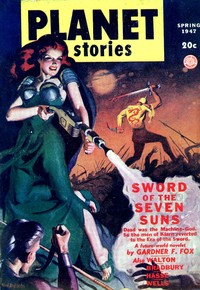
The catalog record for Rocket Summer — A Closer Reading provides practical reading context through 7,661 words, 34 min estimated reading time, and 1 detected text section.
The text analysis averages about 12.6 words per sentence, while the detected sections provide another way to judge how the source is divided.
Project Gutenberg metadata also associates the work with “Science fiction,” connecting these edition facts with the source record’s subject description.
Explore this collection
These alternatives are selected using recorded categories and estimated reading time.
About 35 minutes
Machines Inventions Early Science Fiction
7,923 recorded words. 1 minutes difference from this book's estimate.
View Gutenberg source #66138About 33 minutes
Machines Inventions Early Science Fiction
7,518 recorded words. 1 minutes difference from this book's estimate.
View Gutenberg source #67071About 35 minutes
Machines Inventions Early Science Fiction
7,912 recorded words. 1 minutes difference from this book's estimate.
View Gutenberg source #72082Search stored excerpts and compare books → Choose by your preferences →
Choices use stored catalog measurements. Estimates vary with reading speed. A shared category is a catalog label, not a claim that two books have the same argument or literary quality.
Search reads excerpt text stored with this catalog and links to its associated Gutenberg record. The connection is stored in the site database; this tool does not recheck that every excerpt is word-for-word identical to that external record. Excerpt search does not cover every chapter and does not verify historical publication dates.
Catalog snapshot checked: 2026-09-25. Coverage: 100 public books, 100 available source excerpts.
Read the complete public-domain text at its original source.
Read on Project GutenbergRay Bradbury's 'Rocket Summer' opens with a crowd gathered for the 'Birth' of a Moon rocket, described as a 'titanic Caesarian' that will 'slash wide the skulls of engineers, chemists, mechanics.' The scene immediately establishes a tone of uneasy celebration, with vendors hawking 'Rocket Toys' and 'Rocket teethers' while the protagonist, William Stanley, watches from his office tower with 'sad impatience.' The story's language is visceral and ironic, contrasting the carnival atmosphere with Stanley's grim view of the rocket as 'the gift of a too-generous science to a civilization of adult-children.'
The narrative quickly centers on Stanley's internal conflict. He is described as 'the unhappiest man alive,' burdened by the decision to cancel the flight. The head mechanic, Simpson, confronts him with a wrench in hand, accusing him of delivering a 'still-born' baby. The crowd's behavior is portrayed as both childlike and menacing: they arrive in 'gleaming scarlet tumble-bugs and yellow plastic beetles,' and a small girl's rocket toy is shattered underfoot. Bradbury uses these details to underscore the tension between technological ambition and societal immaturity, a theme that recurs throughout the excerpts.
During the fourteen-day flight, Stanley is 'constantly attacked by fears and confusions of thought.' He dreams of the rocket and recalls the workers 'patting it with their greasy, calloused hands.' The story shifts into a more reflective mode, with Stanley acknowledging the rocket's beauty—'its balance and slenderness of structure'—even as he labels his own hopes as 'ESCAPE.' This internal debate is a key structural element, as the excerpts show Stanley oscillating between admiration for the achievement and dread of its consequences.
The climax is a stark reversal of the opening's excitement. The rocket returns, and the crew emerges not as heroes but as grotesque figures: 'grey-green fingers, raw, bleeding,' faces with 'red things' for eyes, and a captain who can only utter 'Uns—rrrr—oh—god—disss—ease.' The crowd's ecstasy turns to panic, with people trampling each other and souvenir seekers ripping clothes from one another's backs. Bradbury's prose becomes deliberately chaotic, describing 'rubber rockets floating wildly' and sirens wailing. The transformation is left unexplained, but the imagery of disease and decay is unmistakable.
Bradbury's voice is marked by sharp contrasts: the carnivalesque opening gives way to psychological introspection and then to visceral horror. The story uses repetition of the word 'Rocket' as a commercial slogan ('Rocket, Rocket, Rocket!') to critique consumerism. The narrative structure is tightly focused on Stanley's perspective, with the crowd serving as a collective character. The excerpts do not reveal the cause of the crew's condition, leaving the reader to infer that the space voyage has unleashed something unknown. This ambiguity is a deliberate narrative device, forcing the reader to sit with the discomfort of incomplete knowledge.
As you read 'Rocket Summer,' pay close attention to how Bradbury uses the crowd as a barometer for societal reaction—from fervor to panic. The story's brevity (7,661 words) means every detail, from the shattered toy to the 'rocket summer' of the title, carries weight. The excerpts leave the crew's fate and the nature of their affliction unresolved, inviting speculation. This is not a tale of triumphant exploration but a cautionary one, where the cost of progress is written on the bodies of its pioneers.
Rereading “Rocket Summer,” I kept circling back to that crowd’s hunger for spectacle, and the quiet dread underneath. It felt oddly familiar, like a half-remembered dream. I found myself thinking of The Purple Cloud — Inside the Classic, where solitude becomes its own terrifying transformation. Two very different rockets, but the same cold, vast emptiness waiting at the end of human ambition.
Answer a few questions and save a private reflection on this device.









