
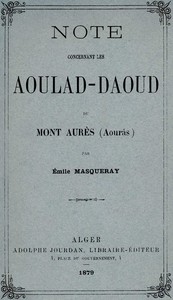
Note concernant les Aoulad-Daoud du Mont Aurès (Aourâs) by Émile Masqueray
Émile Masqueray wasn't a novelist; he was a French official living and working in colonial Algeria in the 1880s. His book, 'Note concernant les Aoulad-Daoud,' is his attempt to answer a specific, burning question: Who are the Aoulad-Daoud? This group lived in the rugged Aurès Mountains, and their name, which means 'Sons of David,' suggested a legendary Jewish or Biblical origin. Masqueray sets out to verify this.
The Story
The plot is the investigation. Masqueray acts like a historical gumshoe, pulling threads from different sources. He listens to the oral traditions of the Aoulad-Daoud themselves. He sifts through the accounts of French military officers who encountered them. He even goes back to medieval Arab historians. What he finds is a mess of contradictions. Some stories paint them as indigenous warriors, others as migrants. The 'Sons of David' claim seems powerful, but is it a deep truth or a useful legend? The book is the record of his search, ending not with a neat answer, but with a clearer picture of how complicated identity really is.
Why You Should Read It
This isn't a page-turner in the usual sense, but it's gripping in its own way. You're peering over Masqueray's shoulder as he works. You feel his frustration when sources disagree and his excitement when he finds a clue. What got me was realizing this isn't just about 19th-century Algeria. It's about how all groups, especially under pressure, craft stories about where they come from. Those stories are about power, pride, and survival as much as they are about history. Reading Masqueray's confused, careful report, you start asking the same questions about your own community's stories.
Final Verdict
Perfect for history buffs who like primary sources, or anyone interested in the anthropology of North Africa. It's also great for readers who enjoy true mysteries where the puzzle is human nature itself. Be warned: it's a scholarly note from 1886, so it's dense in parts. But if you approach it as a time capsule—a snapshot of one man's attempt to understand a complex world—it's surprisingly rewarding. You won't get a Hollywood ending, but you'll get something better: a lot to think about.
This historical work is free of copyright protections. Enjoy reading and sharing without restrictions.
Jennifer Gonzalez
1 year agoVery helpful, thanks.
Linda Davis
2 years agoText is crisp, making it easy to focus.
Donna Torres
2 years agoRead this on my tablet, looks great.
Sarah Robinson
11 months agoComprehensive and well-researched.




Patricia Jones
8 months agoI've been looking for a reliable source on this topic, and the transition between theoretical knowledge and practical application is seamless. I feel much more confident in my knowledge after finishing this.