
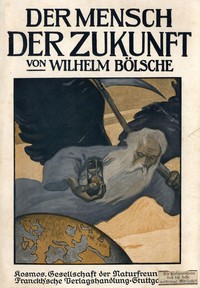
Der Mensch der Zukunft by Wilhelm Bölsche
Let's set the scene. Wilhelm Bölsche was a key figure in a late-19th century German movement that tried to blend science, art, and a new, modern worldview. In Der Mensch der Zukunft, he takes Charles Darwin's theory of evolution and pushes it as far as his imagination will allow. The book isn't a novel with characters and a plot in the traditional sense. Think of it as a guided tour of a possible future, led by a very enthusiastic and knowledgeable docent.
The Story
There's no protagonist chasing an antagonist here. Instead, Bölsche builds his vision step-by-step. He starts with the basics of evolution and heredity, explaining how traits are passed down and slowly change over generations. Then, he applies this logic forward—way forward. He speculates on how our bodies might adapt: Will our brains get bigger? Will useless body parts, like our little toes, disappear? He then moves beyond the physical to the social and ethical. What will family look like? How will art and religion change when viewed through a purely scientific lens? The 'story' is the logical (and sometimes poetic) progression of these ideas across an almost unimaginable span of time.
Why You Should Read It
This book is a fascinating snapshot of a moment when science felt like it could explain and even design everything, including humanity's ultimate fate. Bölsche's optimism is palpable; he truly believed a scientific understanding of the world would lead to a better, more rational, and more beautiful future. What I find most compelling, though, are the moments where his 19th-century biases peek through. His ideas about beauty, gender roles, and society are firmly of his time, which makes his predictions about transcending human nature quietly ironic. Reading it is a double experience: you're marveling at his forward-thinking ideas while also seeing the limits of his own historical moment.
Final Verdict
This one is perfect for readers who love ideas for their own sake. If you're into the history of science, curious about vintage futurism, or just enjoy seeing how a smart person from the past tried to make sense of tomorrow, you'll get a kick out of this. It's not a light beach read, but it's also not a dry textbook. It's the passionate, slightly quirky manifesto of a man who looked at the theory of natural selection and saw not just our past, but a blueprint for our destiny. Approach it as a historical artifact and a mind-expanding exercise, and you'll be richly rewarded.
This is a copyright-free edition. You do not need permission to reproduce this work.
Jessica Moore
4 weeks agoComparing this to other titles in the same genre, the practical checklists included are a great touch for real-world use. Finally, a source that prioritizes accuracy over hype.
Christopher Thompson
1 month agoI was skeptical about the depth of this book at first, but the insights into future trends are particularly thought-provoking. This has become my go-to guide for this specific topic.
Charles Martin
6 months agoAs a professional in this niche, the author’s unique perspective adds a fresh layer to the discussion. Well worth the time invested in reading it.
Paul Johnson
2 months agoHaving explored several resources on this, I find that the practical checklists included are a great touch for real-world use. This exceeded my expectations in almost every way.







Ashley Taylor
5 months agoI was skeptical about the depth of this book at first, but the chapter on advanced strategies offers insights I haven't seen elsewhere. The price-to-value ratio here is simply unbeatable.