
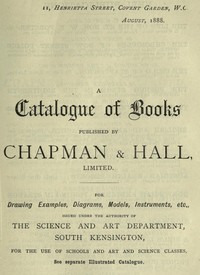
A Catalogue of Books Published by Chapman & Hall, Limited, August, 1888
Let's be clear from the start: this is not a storybook. You won't find chapters, characters, or a plot twist on page 47. What you will find is a meticulous, dry-as-bones listing of every title Chapman & Hall had available for purchase in August 1888. We're talking hundreds of entries, organized by series and price, from cheap sixpenny reprints to fancy multi-volume sets. It's a snapshot of a business at a specific moment in time.
The Story
There is no traditional narrative. The 'story' is in the patterns you discover. You'll see Charles Dickens everywhere (Chapman & Hall was his publisher), alongside now-forgotten novels with titles like A Girl of the People. There are travelogues about Persia, manuals on telegraphy, serious histories, and volumes of poetry. It's the entire literary diet of the late Victorian era, laid out in neat columns. Reading it is an act of historical detective work. You start to ask questions: Why are there so many books about the British Navy? Who was buying all these guides to household management? The catalog itself is silent, but the collective weight of its entries tells a bigger story about ambition, entertainment, and knowledge in 1888.
Why You Should Read It
I loved it for the weird, intimate connection it creates. Holding this list is like eavesdropping on the past. You see the birth of modern publishing—the 'Railway Library' series meant for train travel, the specific marketing of books 'suitable for prizes and presents.' More than anything, it humanizes history. These weren't just 'Victorians'; they were people who wanted to laugh at a satire, learn a new skill, or get lost in a romance, just like us. It makes that vast, often intimidating period feel concrete and familiar. It's also a sobering reminder of how most art fades; for every Dickens, there are fifty authors whose names mean nothing today.
Final Verdict
This is a niche read, but a fascinating one. It's perfect for history buffs, book collectors, or writers who want to understand the literary landscape of the era. If you love getting lost in the details of the past, you'll find it strangely compelling. If you need a driving plot, you'll be bored in two minutes. Approach it not as a book to be read cover-to-cover, but as a museum exhibit you can browse. Dip in, look around, and let your imagination fill in the gaps between the lines.
This publication is available for unrestricted use. You do not need permission to reproduce this work.
Deborah Hernandez
9 months agoSolid story.
Joseph Garcia
1 year agoClear and concise.






Mason Nguyen
1 year agoThis book was worth my time since it creates a vivid world that you simply do not want to leave. A valuable addition to my collection.